
Macromolecule: a very large molecule such as a protein.
Molecule: a chemical structure that has two or more atoms held together by a chemical bond. Water is a molecule of two hydrogen atoms and one oxygen atom (H2O)... more
What Are the Ingredients for Life?
If you look around your neighborhood you will see homes, stores, streets and cars. All of these things are made from different building materials. The homes and stores are made from bricks, cement, wood and nails. The roads are made from asphalt or cement. All the cars are made from metal, glass, rubber and plastic.
When you look around you also see plants and animals. Just like the buildings and cars in your neighborhood, living things are made from building materials.
What Are Living Things Made from and How Are the Parts Put Together?
As you can see from the list below, life on Earth is built from increasingly more complex building blocks. At the widest view you have all living and non-living things - Earth. Soon you learn that each building block seems to be made of smaller building blocks - until you reach the smallest building blocks with the funny name - quarks.
The list below deals with living things and how each building block is made from yet a smaller set of building blocks.
 |
Biosphere - Our Earth is made up of all living and non-living things. The interaction of all these building blocks make up the biosphere. |
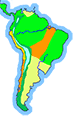 |
Biomes - The different environments on Earth are all unique, but there is a way for us to group areas by habitat type, such as tropical rainforest, desert, or marine environment. These are called biomes. You can think of biomes as specific areas on Earth that are defined by the plants and animals that live in that geographic region. Within a biome it is possible to have many ecosystems. |
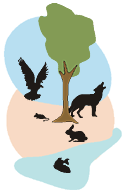 |
Ecosystems - All living things interact with non-living things around them. All the animals and plants in an area, plus the non-living things around them (air, earth, water, etc.) make up an ecosystem. Ecosystems can be various sizes, from an entire desert to a small pond. |
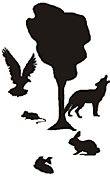 |
Communities - All animals and plants that live in one place are considered a community. This can be tricky when you include humans, because they can move from community to community. There are also other animals, such as birds and butterflies that migrate from community to community. Communities do not include the non-living things in that place or area. |
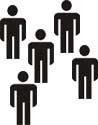 |
Populations - All the individuals of one species that live in an area are called a population. In this way, individuals become the building blocks for a species. For example, the entire human population is made of billions of people, who interact with each other to make up this world we live in. We can also specifically talk about the human population of one country, one city, or one neighborhood. |
 |
Individuals - Individual people make up the population. Each person has their own individual characteristics that cause diversity within a population. |
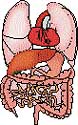 |
Organs and Tissues - The human body, like all plants and animals, is made up of organs. In humans, these are the brain, heart, kidneys, liver, etc. Each organ is made of different tissues. These tissues have their own characteristics and functions. Did you know the largest organ in the body is the skin and that you are not wearing the same skin that you were born with? |
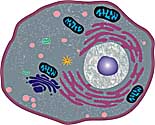 |
Cells - Tissues are made of cells. The cell is the smallest unit of life. What does that mean? It means that the cell is the smallest living thing capable of replicating. |
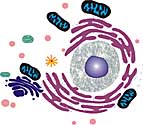 |
Organelles - Cells are also made up of individual parts. The interior of any cell has many types of little organs called organelles, such as the nucleus, mitochondria, Golgi complex, etc. All these organelles have their own functions to perform within the cell. |
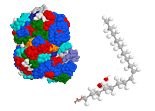 |
Proteins - Fats - Carbohydrates - Nucleic Acids- What are organelles made of? All the cellular organelles are made of macromolecules like carbohydrates, Lipids, Proteins, and Nucleic acids (DNA, RNA). |
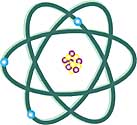 |
Atoms - To make macromolecules involves even smaller building blocks. You may have heard of atoms before and their parts: neutrons, protons, and electrons. There are 92 naturally occurring atoms (also called elements) but only 11 of these atoms are found in a significant amount in living things. It takes only two atoms to make a molecule. |
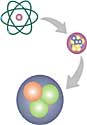 |
Quarks - For many years it was thought that the smallest building blocks were atoms, but now we know that is not true. Scientists have found even smaller building blocks than atoms. These subatomic particles have a funny name - quarks. There are many "flavors" of quarks. Their names are up, down, top, bottom, charm, and strange. |
References:
Building Pig illustration by L. Leslie Brooke, from The Golden Goose Book, Frederick Warne & Co., Ltd. 1905. From Project Gutenberg.
Read more about: Building Blocks of Life
You may need to edit author's name to meet the style formats, which are in most cases "Last name, First name."
https://askabiologist.asu.edu/ingredients-life
Bibliographic details:
- Article: Ingredients for Life
- Author(s): Dr. Biology
- Publisher: Arizona State University School of Life Sciences Ask A Biologist
- Site name: ASU - Ask A Biologist
- Date published: 27 Sep, 2009
- Date accessed:
- Link: https://askabiologist.asu.edu/ingredients-life
APA Style
Dr. Biology. (Sun, 09/27/2009 - 07:29). Ingredients for Life. ASU - Ask A Biologist. Retrieved from https://askabiologist.asu.edu/ingredients-life
American Psychological Association. For more info, see http://owl.english.purdue.edu/owl/resource/560/10/
Chicago Manual of Style
Dr. Biology. "Ingredients for Life". ASU - Ask A Biologist. 27 Sep 2009. https://askabiologist.asu.edu/ingredients-life
Dr. Biology. "Ingredients for Life". ASU - Ask A Biologist. 27 Sep 2009. ASU - Ask A Biologist, Web. https://askabiologist.asu.edu/ingredients-life
For more info, see http://owl.english.purdue.edu/owl/resource/717/04/
MLA 2017 Style
Modern Language Association, 7th Ed. For more info, see http://owl.english.purdue.edu/owl/resource/747/08/

What does it take to build a living thing?
Be Part of
Ask A Biologist
By volunteering, or simply sending us feedback on the site. Scientists, teachers, writers, illustrators, and translators are all important to the program. If you are interested in helping with the website we have a Volunteers page to get the process started.
