






show/hide words to know
Decontaminate: using one of many methods to remove dangerous materials, such as dangerous bacteria and viruses, from an area.
Fungus: an organism that is part of the kingdom called fungi which includes yeasts, molds, and mushrooms. Fungi mainly feed on decaying organic matter... more
Hibernacula: places where animals hibernate during cold winter months.
White-nose Syndrome - A Deadly Mystery
Bats in the eastern United States are dying and no one knows why. Scientists have noticed that dead bats have a mysterious white fungus growing on their nose, wings, and tail so they have named the culprit white-nose syndrome (WNS). But is the white fungus killing these bats, or is it is something else? This is the mystery and for bats a deadly one. Most recent research points to the fungus Pseudogymnoascus destructans as the main cause of WNS.
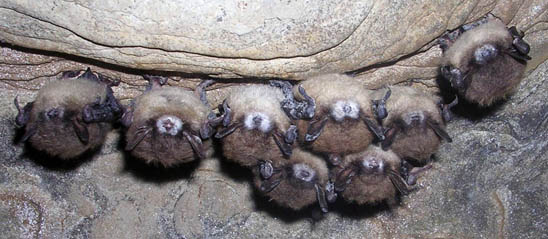
Little brown bats with white-nose syndrome. Image courtesy of NYS Department of Environmental Conservation.
So far more than 1 million bats have died from white-nose syndrome and this number is increasing every winter. Dead bats have been found in and around caves and mines in 10 eastern states ranging from New Hampshire to Tennessee. Bats that live in these states often hibernate in caves and mines to survive during cold winter months.
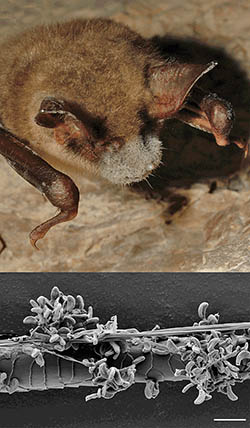
Greater mouse-eared bat (Myotis myotis) with white fungal growth around its nose, ears, and wing membranes (top). Scanning electron micrograph of a bat hair with the fungus originally classified as Geomyces destructans (bottom). After additional research the fungus was placed in the family Pseudeurotiaceae. The white line is equal to 10 micrometers.
Healthy bats will find a cave or a mine to hibernate in during autumn when the temperature starts to get cold. They hibernate all winter and wake up in the spring when the temperature is warm again. But bats with white-nose syndrome are acting a bit unusual. These bats hang out in cold sections of the cave or mine, fly during the day when bats are supposed to be asleep, and even leave their hibernacula in the middle of winter. Unfortunately, these bats often die in the freezing winter temperatures.
Scientists, state and federal agencies, and non-government groups are working together to solve the white-nose syndrome mystery. These groups hope to solve this case soon before even more bats are reported dead.
Where Are Bats Getting Sick with White-Nose Syndrome?
The first bats with white-nose syndrome appeared in 2006 and only in a few sites in New York. Since that time it is quickly spreading throughout the U.S. The occurrence of WNS in Tennessee just occurred this February of 2010. At this time there does not appear to be any signs of the syndrome in other parts of the world.

Updated map showing the spread of WNS from 2006 to 2015. Map by Lindsey Heffernan, PA Game Commission. Click to to enlarge.
How is WNS Spread?
There is strong evidence that humans spread the fungus from cave to cave. Spelunkers are thought to be the main cause for the spread of WNS. Since 2008 the protocol for cave explorers is to decontaminate their clothing, shoes, boots and equipment before visiting a new cave to reduce the spread of Pseudogymnoascus destructans. Since 2012 more strict procedures have been added to reduce the spread of the fungus. They include not reusing clothing, footwear, and equipment, even if decontaminated, and instead using new clothing, footwear and equipment when exploring caves.
Map Source: U.S. Fish & Wildlife Service
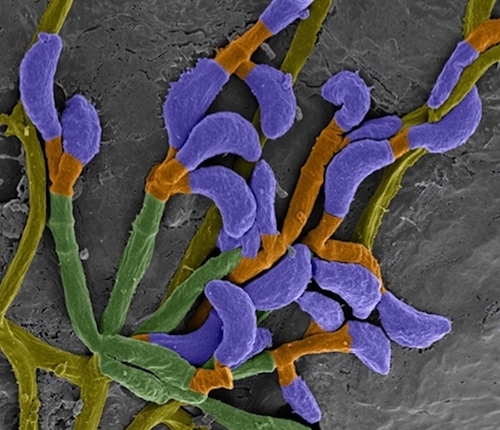
Scanning electron microscope image of fungal hyphae and spores is from PLOS journal article - Morphological and Molecular Characterizations of Psychrophilic Fungus Geomyces destructans from New York Bats with White Nose Syndrome (WNS). Retrieved from https://journals.plos.org/plosone/article?id=10.1371/journal.pone.0010783 on September 3, 2012.
Image of Greater mouse-eared bat (Myotis myotis) with white fungal growth around its muzzle, ears, and wing membranes (photograph provided by Tamás Görföl) via Wikimedia.
National White-Nose Syndrome Decontamination Protocol.
View Citation
Bibliographic details:
- Article: White-Nose Syndrome
- Author(s): Elizabeth Hagen
- Publisher: Arizona State University School of Life Sciences Ask A Biologist
- Site name: ASU - Ask A Biologist
- Date published: February 17, 2010
- Date accessed: April 17, 2024
- Link: https://askabiologist.asu.edu/white-nose-syndrome
APA Style
Elizabeth Hagen. (2010, February 17). White-Nose Syndrome. ASU - Ask A Biologist. Retrieved April 17, 2024 from https://askabiologist.asu.edu/white-nose-syndrome
Chicago Manual of Style
Elizabeth Hagen. "White-Nose Syndrome". ASU - Ask A Biologist. 17 February, 2010. https://askabiologist.asu.edu/white-nose-syndrome
Elizabeth Hagen. "White-Nose Syndrome". ASU - Ask A Biologist. 17 Feb 2010. ASU - Ask A Biologist, Web. 17 Apr 2024. https://askabiologist.asu.edu/white-nose-syndrome
MLA 2017 Style

Coloring Pages
and Worksheets

Puzzles
Be Part of
Ask A Biologist
By volunteering, or simply sending us feedback on the site. Scientists, teachers, writers, illustrators, and translators are all important to the program. If you are interested in helping with the website we have a Volunteers page to get the process started.
