
Algorithm: a clear set of step-by-step instructions used to solve a problem or complete a task.
Augment: to add something extra to something else, which may improve it, change it, or expand it.
Emergent: something new that shows up when smaller parts come together and work as a whole.
Career Path for Joshua Daymude
Fast Facts:
- Number of years in school: 19
- Favorite class / subject: Bio-inspired Algorithms
- Hardest class / subject: Topology
- First Job: Hardware Engineer
- Dream job as a kid: Firefighter
- One word you would use to describe your current job: Sisyphean
From Ranch Life to Rocket Science
The sun sets behind the mountains in Lebec, a quiet town in Southern California. Joshua Daymude hikes a dusty trail near his family’s ranch, surrounded by farms, horse ranches, and fields of wildflowers. The air smells like pine, and crickets chirp in the background as he kicks up little clouds of dirt with his boots. At the top of the hill, he stops to take it all in...the golden sky, the endless fields, and the mountains stretching out forever. There’s no one else around for miles. The nearest grocery store is a 40-minute drive in the town where he grew up.

This was Daymude’s childhood. Lebec was remote and peaceful, a place where mountains and fields were his playground, and every trail could lead to a new adventure.
But becoming a scientist? That wasn’t even on his radar. “I didn’t even know what scientists did!” he admits with a laugh, remembering his younger self. As a kid, Daymude dreamed of becoming a firefighter, imagining the excitement of battling flames and saving lives. But that dream didn’t stick. He quickly discovered that his fear of heights might be a problem.
As Daymude grew, his love for learning flourished, and science became his favorite subject. His parents encouraged high aspirations, and in high school, an online math and programming course sparked his interest. A visit to a family friend studying computer science further inspired him, leading him to pursue computer science and math in college. That paved the way for his career as a scientist.
Space Robots, Google, and Big Questions
Years later, Daymude’s love for science took him to Pasadena, where he worked on exciting projects during an internship at NASA’s Jet Propulsion Laboratory (JPL), a place where scientists build robots and spacecraft to explore space. “NASA was an awesome experience,” he says. “If I weren’t a professor, I’d love to work at a research lab like that.”
During his PhD, Daymude had a chance to experience the fast-paced world of Silicon Valley as a Google intern. At first, it seemed like the ultimate dream: working on cutting-edge projects like Google Maps, enjoying gourmet meals, and soaking up the energetic tech culture. But as the summer went on, something felt off. “It was like eating too much candy,” he recalls. “At first, it’s exciting, but then you feel sick. I was paid a lot to do work that felt... meaningless.”
He realized big tech didn’t align with his values, focusing more on profit than creativity. Although he loved the scientific aspect, the work lacked significance. This experience led him to pursue academia, where he could explore meaningful ideas. “I wanted the intellectual freedom that academia offers,” he says.
Playing Video Games to Become a Better Scientist
That same curiosity and drive to uncover answers show up even outside his work. One of Daymude's favorite ways to explore and think like a scientist is through video games...especially Outer Wilds.

Imagine exploring a mysterious universe where every discovery feels like a key to unlocking something bigger. For Daymude, this sense of discovery isn’t just part of his job—it’s part of his favorite game, Outer Wilds. “It’s the only game I’ve ever played that truly feels like being a scientist,” he says.
In Outer Wilds, players are thrown into a beautiful imaginary universe with no instructions. You must solve mysteries by decoding ancient writings and experiment with alien technology on different planets. Every time you try to understand this universe, you learn something new, just like how scientists use a "trial and error" process. Scientists try different things and learn from their mistakes. Daymude describes the excitement of hitting a breakthrough in the game: “There’s this incredible moment, hours in, where everything finally clicks... and you realize what’s been happening all along. That’s exactly what it feels like to nail a scientific result.”
For Daymude, games like Outer Wilds are more than just fun — they reflect how he approaches his role as a computer scientist. As an Assistant Professor in the School of Computing and Augmented Intelligence at Arizona State University, he leads a team of researchers exploring big questions about group behavior, algorithms, and emergent systems. Much like in the game, all his projects start with curiosity, patience, and a willingness to experiment until the pieces of the puzzle finally fit.
If Daymude weren’t a scientist, he knows exactly what he’d be doing — writing reviews for games. “I really wanted to be a games journalist,” he says. “I wanted to write about video games and board games for a living, not just reviewing and rating them, but also exploring their role or impact in broader society.” Although he didn’t pursue games journalism as a career, his passion for creativity and discovery shines through in both his work and hobbies.
Whether he's leading a team of researchers or exploring a virtual world, Daymude's career is all about one important idea: his love for exploring and the excitement of solving big questions. This passion drives him to discover new things and make the world a better place!
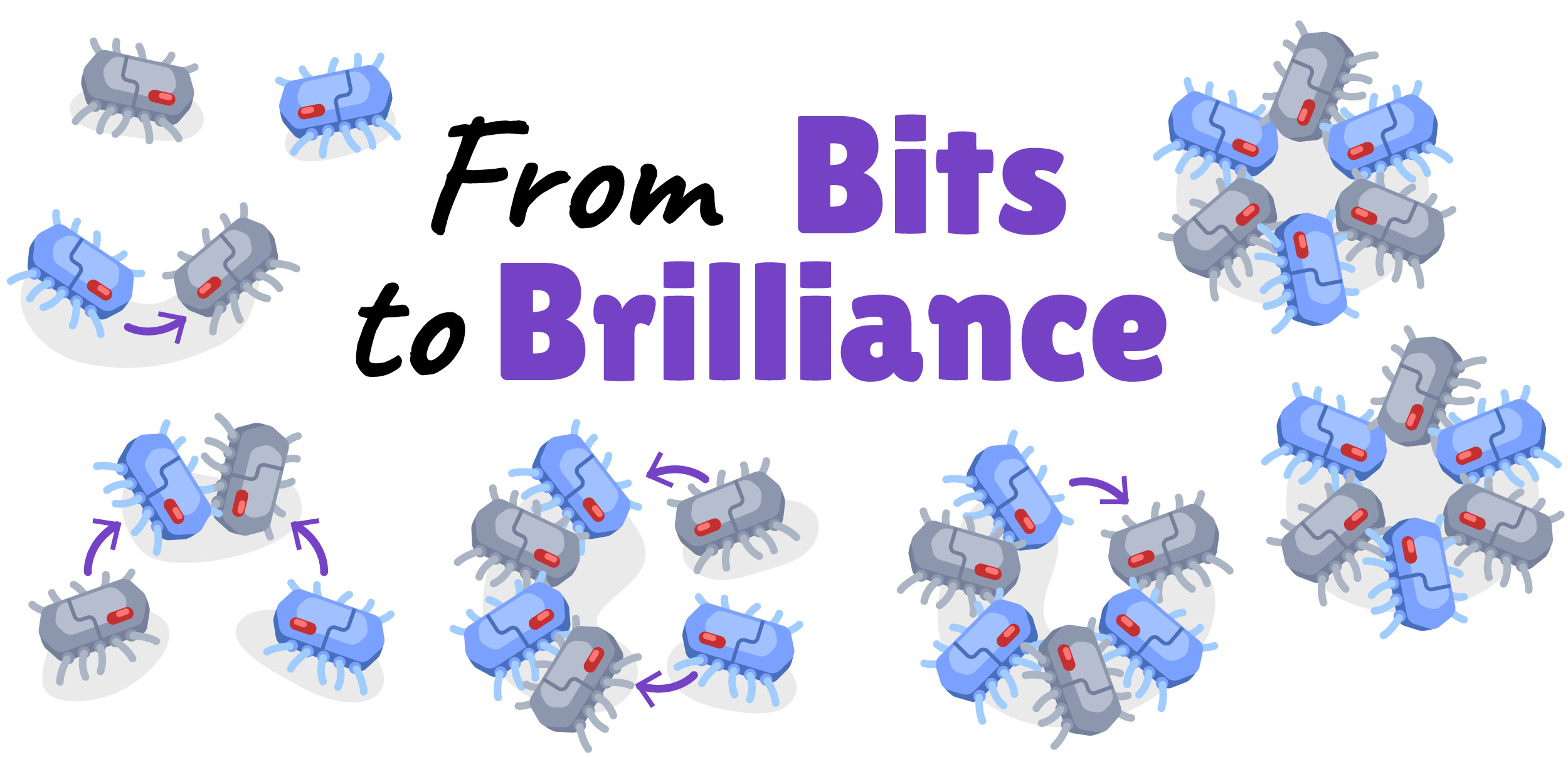
From Bits to Brilliance was created in collaboration with the Biodesign Institute at ASU.
Read more about: From Bits to Brilliance
You may need to edit author's name to meet the style formats, which are in most cases "Last name, First name."
https://askabiologist.asu.edu/career-path-joshua-daymude
Bibliographic details:
- Article: Career Path: Joshua Daymude
- Author(s): Dr. Biology
- Publisher: Arizona State University School of Life Sciences Ask A Biologist
- Site name: ASU - Ask A Biologist
- Date published:
- Date accessed:
- Link: https://askabiologist.asu.edu/career-path-joshua-daymude
APA Style
Dr. Biology. (). Career Path: Joshua Daymude. ASU - Ask A Biologist. Retrieved from https://askabiologist.asu.edu/career-path-joshua-daymude
American Psychological Association. For more info, see http://owl.english.purdue.edu/owl/resource/560/10/
Chicago Manual of Style
Dr. Biology. "Career Path: Joshua Daymude". ASU - Ask A Biologist. . https://askabiologist.asu.edu/career-path-joshua-daymude
Dr. Biology. "Career Path: Joshua Daymude". ASU - Ask A Biologist. . ASU - Ask A Biologist, Web. https://askabiologist.asu.edu/career-path-joshua-daymude
For more info, see http://owl.english.purdue.edu/owl/resource/717/04/
MLA 2017 Style
Modern Language Association, 7th Ed. For more info, see http://owl.english.purdue.edu/owl/resource/747/08/

Joshua Daymude studies computer science and emergent behavior. Focusing on group behaviors like flocking birds, grassroots organizing, and more, he studies how small rules can help form big behaviors.
Be Part of
Ask A Biologist
By volunteering, or simply sending us feedback on the site. Scientists, teachers, writers, illustrators, and translators are all important to the program. If you are interested in helping with the website we have a Volunteers page to get the process started.
