
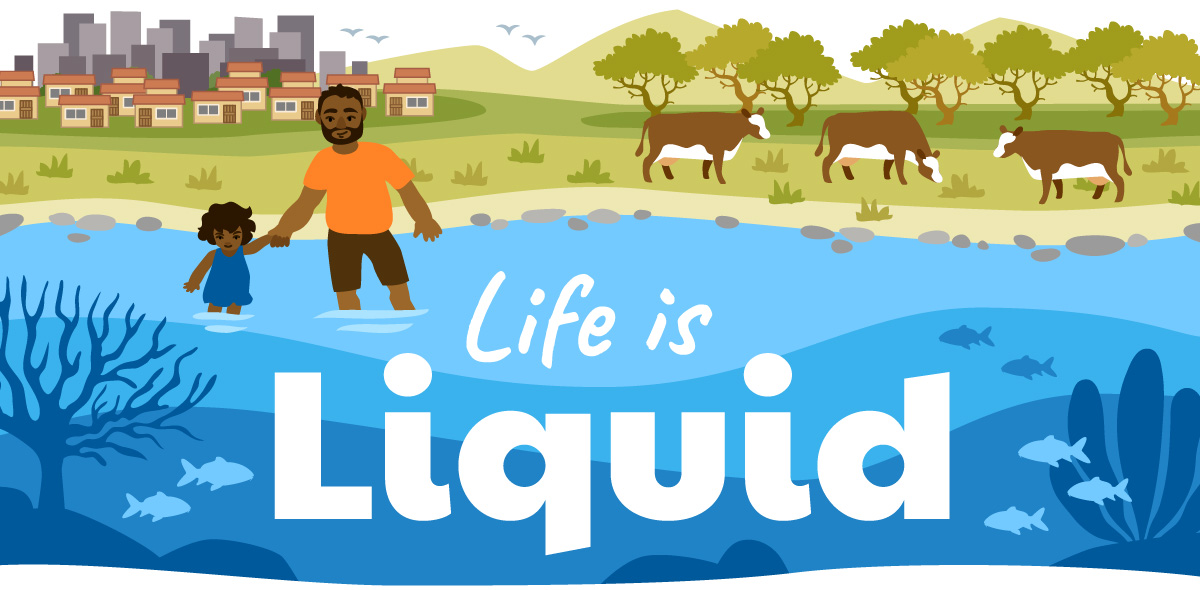
Life is liquid
Written by: Celeste Kenworthy
Illustrated by: Sabine Deviche
Illustrated by: Sabine Deviche
Digestion: the process organisms use to break food down so that it can be used for energy.
Evaporation: the process of a liquid being turned into a gas.
Photosynthesis: a set of chain reactions that convert light energy into chemical energy. Photosynthesis also produces energy-rich carbohydrates like starch. Photosynthesis occurs in the chloroplast of a plant cell... more
Precipitation: water that falls from the atmosphere, whether as rain, snow, or another form.
Semiaquatic: an animal that lives partly on land and partly in water.

You are outside on a hot day, watering your plants. As you set down your watering can, you spot a bird splashing in the bird bath. You wipe your brow and reach for a glass of ice water, taking a deep, cool sip.
You, the plants, and the birds in your yard have one major thing in common – you all need water.
All living things need water, from plants to animals to fungi. Let’s take a quick look at how organisms use water.
Why do we need water?
Plants and animals (including humans) need water for many of the same reasons. For any of our bodies to function, the molecules inside need a fluid to move through. Nutrients are dissolved in water and carried throughout the bodies of organisms. All organisms also require water to either produce energy or break down tissues into energy. Plants use water for photosynthesis. Animals use water for digestion. Fungi need water to release special enzymes into the tissues they are breaking down.
As you may have noticed on a hot day, humans use water to keep cool by sweating. Most other animals don’t sweat, but some use water to keep cool in other ways. Dogs, cats, and birds can pant to cool off. Pigs, hippos, and buffalo may wallow, or roll around in mud, to cool down. All of these methods use evaporation to keep animals cool. Plants can also use evaporation of water to keep from getting too hot. In transpiration, water evaporates from the leaves which cools the plant.
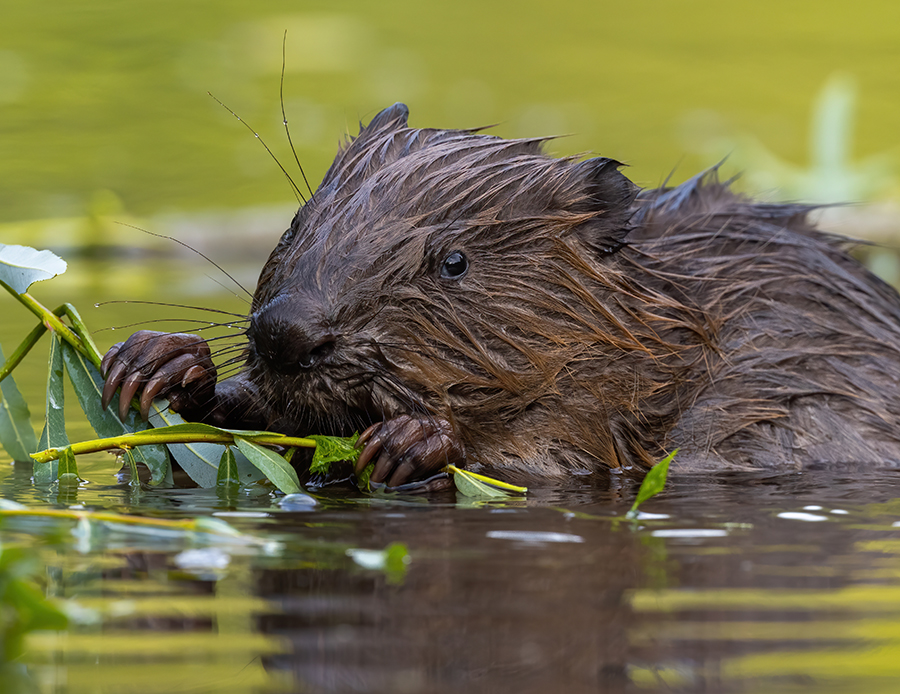
Some plants and animals go beyond just using water in their bodies; they also live in the water. Plants like water lilies and java moss grow entirely in water. Other plants like cattails and mangrove trees are found along the edges of bodies of water. Many animals, like fish, sharks, whales, and coral live underwater.
Other animals are semiaquatic, which means they live part of their lives in water. These are animals like beavers, crocodiles, penguins, and seals. And still other animals, like certain insects, spend only part of their life cycles in the water.
Humans also need water. Our bodies are more than 50% water. But we use water for many things beyond just keeping our bodies hydrated. We use water to shower, brush our teeth, and flush our toilets. We enjoy water for recreation by swimming, kayaking, and boating. Water is also used in manufacturing, and we’ve even built dams that let us create electricity using water. So you see, water isn’t just important—none of us could live without it.

What’s in the water?
Splashing around in the ocean, you get some water in your mouth. You spit it out instinctively. You know this type of water isn’t for you. Yet looking closer at the water, you can spot some of the many animals and plants that thrive there.
Water itself is made up of molecules that have two hydrogen atoms bound to one oxygen atom. But water often also holds suspended material, bacteria, and minerals, like salt. The amount of salt and other materials in water can affect which organisms can use it.
Most sea creatures can only live in salt water. Most animals on land need to drink fresh water, or water without much salt. But salinity is only one part of water quality.
Water quality is based on the properties of water, like the temperature and presence of contaminants. The qualities of water affect which living organisms can use it. For example, coral reefs do best in water that is unpolluted and low in nutrients. Algae thrive in warmer water that is high in nutrients. West Indian manatees prefer the warm water of the tropics, while beluga whales thrive in cold Artic waters.

Water quality issues can be associated with diseases or health risks. We may see this most clearly from frogs growing in polluted waters. Certain pollutants can cause developmental issues like the growth of extra legs in those frogs. Humans should also drink clean water to stay their healthiest. It’s important we have water free of contaminants and suspended material. But finding clean freshwater can be harder than you might think.
Where is the water?
Earth is called the blue planet for a reason. About 71% of Earth’s surface is covered by water. Most of Earth’s water is salt water found in oceans and seas.
If you had to guess, how much of the water on Earth do you think is fresh water (the water we need to drink)? Ready for the answer?
Less than 4%! Lakes and rivers often come to mind when we think of fresh water, but they contain less than half of a percent of all the fresh water on Earth. Most fresh water is frozen, stored in glaciers and ice caps. Most of the rest of the fresh water is stored underground, as groundwater.

Even though there is so much water on Earth, some places are drier than others. Areas that receive very little precipitation are known as deserts. Some plants and animals have adapted to be able to live in these very dry places.

Kangaroo rats are able to get all the water they need from their food. Some types of cacti can live for years without water. And some seeds and small invertebrates, like brine shrimp, can dry up almost completely between rains. They wait in a seemingly dead, dehydrated state (sometimes for years) until water from the next rain brings them to life again.
Sometimes areas receive less water than usual. This is known as a drought, which usually results in water shortages. Without enough water, many plants and other organisms could die. If many plants die, animals’ habitats may be damaged, and they may not have enough food or water. With less rain, groundwater may not be replenished. Drought can also lead to other natural disasters, like wildfires and dust storms. Climate change affects the frequency and severity of droughts.
Renewable resource?
Water is often called a renewable resource because it moves around the planet and through earth in the water cycle.

Water cannot be used up entirely, but the amount available as freshwater can decrease and needs to be protected. What’s more, many people around the world do not have access to clean freshwater.
Water provides hydration and habitat for all living things. Entire ecosystems can be damaged by changes in water quality or quantity. This is why it is important to conserve and protect our water resources.
Additional images via Wikimedia Commons and Adobe Stock. Photo of Arizona Falls by Chris Goulet.
Read more about: Life is liquid
You may need to edit author's name to meet the style formats, which are in most cases "Last name, First name."
https://askabiologist.asu.edu/explore/importance-of-water
Bibliographic details:
- Article: Life is liquid
- Author(s): Celeste Kenworthy
- Publisher: Arizona State University School of Life Sciences Ask A Biologist
- Site name: ASU - Ask A Biologist
- Date published:
- Date accessed:
- Link: https://askabiologist.asu.edu/explore/importance-of-water
APA Style
Celeste Kenworthy. (). Life is liquid. ASU - Ask A Biologist. Retrieved from https://askabiologist.asu.edu/explore/importance-of-water
American Psychological Association. For more info, see Purdue's OWL APA style guide
Chicago Manual of Style
Celeste Kenworthy. "Life is liquid". ASU - Ask A Biologist. . https://askabiologist.asu.edu/explore/importance-of-water
Celeste Kenworthy. "Life is liquid". ASU - Ask A Biologist. . ASU - Ask A Biologist, Web. https://askabiologist.asu.edu/explore/importance-of-water
For more info, see Purdue's Chicago style guide
MLA 2017 Style
Modern Language Association, 7th Ed. For more info, see Purdue's MLA style guide

Water flows at Arizona Falls, a portion of the canal system in Arizona. Every living organism on Earth depends on water.
 Other Biomes
Be Part of
Ask A Biologist
By volunteering, or simply sending us feedback on the site. Scientists, teachers, writers, illustrators, and translators are all important to the program. If you are interested in helping with the website we have a Volunteers page to get the process started.
