

Sending germs to space
Written by: Kayla Burgher
Illustrated by: Sabine Deviche
Illustrated by: Sabine Deviche
Space is a harsh place that the human body cannot easily survive. Astronauts face extreme heat and cold, radiation, and low gravity. But there is another, sneakier danger. Tiny infectious microbes, or germs, can make astronauts sick.
Jennifer Barrila is a microbiologist who studies how infections work. But not just here on Earth… she wants to understand how germs infect their hosts in the low gravity of space. Barrila conducts experiments both in space and in her lab on Earth to unravel this mystery. Her work helps protect astronauts from getting sick in space. But it could also help us control diseases on Earth.
What do germs do in space?
In the early days of space travel, scientists noticed that astronauts are more likely to get sick in space. Low gravity, lack of sleep, and other stressors weaken the immune system. This lowers the body’s natural defenses and makes it easier for germs to infect the astronauts. Yet focusing on the human immune system only looks at half the picture.

Germs are also affected by the harsh space environment. For example, some germs become more infectious in space. Salmonella is a common germ that causes food poisoning when it gets inside our guts. Scientists grew Salmonella samples in space, then used the samples to infect mice back on Earth. The mice infected with the germs grown in space were less healthy than the mice infected with germs grown on Earth. But what about the germs changed to make them more infectious?
Early in her career, Barrila was a postdoctoral researcher at the Biodesign Institute at Arizona State University. There, as part of Cheryl Nickerson's lab, Barrila took part in a groundbreaking experiment to learn more about this question. She was involved in the first experiment where scientists infected human cells in space! In her lab, Barrila prepared samples of Salmonella, along with tiny samples of human gut tissue. She and the rest of the team loaded them into an automated machine, which was sent off to the International Space Station. In that machine, the intestinal cells would grow into three-dimensional structures that mimic the intestines in the human body. Once in space, the machine combined the Salmonella and human tissue samples. The infections began.
After six hours, a special liquid was added to the mix to completely freeze any activity. When the experiment returned to Earth, Barrila could see the infections exactly how they were in space. She looked at which genes were turned on or off in both the Salmonella and the human cells. She also examined the proteins inside the cells. Then, she compared what she found in the space samples to samples she infected on Earth.
What she found was unexpected. Normally, scientists can use certain genes to tell if a germ is highly infectious. They use them as markers to predict if a germ will be good at infecting. But when Barrila looked at the Salmonella that had been to space, she didn’t see the usual markers of a highly infectious germ. Something else caused the Salmonella to become more infectious in space in an unexpected way. It was the so-called "low fluid shear" environment that is associated with weak or low gravity.
Fluid shear
In low gravity, the physical forces affecting our bodies, germs, and all other matter are very different than on Earth. But there is one type of physical force that has a huge impact on germs and infections, called fluid shear.
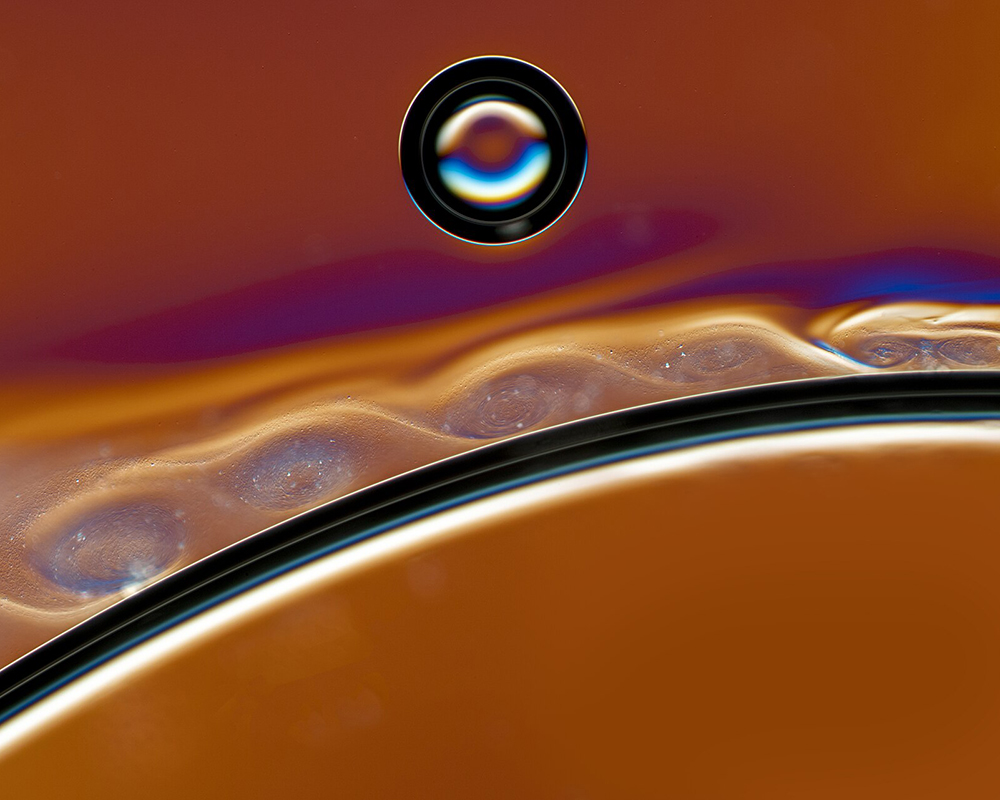
Fluid shear refers to how strongly a liquid rubs against another object. Imagine sitting in a lake with calm water. The water doesn’t move much around you, so this is a low fluid shear environment. Now imagine sitting in a river with water rushing past you. This is a high fluid shear environment, where the pressure and friction from the water is much stronger.
Inside the human body, fluid moves around differently depending on where it is in your body. For example, near the walls of our intestines, liquid moves very slowly, creating low fluid shear. But in the middle of our intestines, liquid flows more quickly, creating a high fluid shear environment. Low fluid shear is also found in the low gravity of space. Without the force of gravity to pull on liquids, they don’t move as rapidly past each other.
ASU Professor Cheryl Nickerson discovered that fluid shear is one of the key forces that impacts infections in space and on Earth. This discovery laid the foundation for the research that Barrila performs now. Some germs, like the Salmonella strain that Nickerson and Barrila sent to space, are more infectious in low fluid shear environments, like those experienced on the space station. Yet the team also found that other bacterial strains are more infectious in high fluid shear environments. These other Salmonella strains are more often associated with dangerous bloodstream infections.
Researching space on Earth

Space experiments can teach us a lot about infections in low gravity. But they are also costly, difficult, and very time consuming. To get around these challenges, Barrila uses a unique way to continue her research on Earth. She uses a special NASA technology, called a rotating wall vessel bioreactor. These bioreactors have small cylinder chambers that rotate very fast. The rotation of these chambers can keep cells in suspension under low fluid shear conditions.
To mirror the environment of space, Barrila usually grows her cells in low fluid shear. This lets her learn a lot about the germs, the infection, and the effects on the infected cells. Barrila measures how severe an infection is, how much damage it causes, and how well the host survives. The bioreactors are not a perfect model of space, but they help Barrila and the rest of the research team predict Salmonella behavior in spaceflight. She gains lots of valuable information that can guide her future experiments in space.
From infection to health
Illness in space can wreak havoc on crew and compromise mission objectives. Barrila’s research helps protect the health of astronauts during space missions. She is looking for ways to make germs less infectious and less dangerous. That way, astronauts have one less threat to worry about in the harsh space environment.
Barrila’s work can also help us control and prevent infection on Earth. The bioreactors she uses closely mimic what’s going on inside the human body, more so than if these cells were grown in a quiet Petri dish. In addition to recreating the space environment, the bioreactors also mimic the low fluid shear environment near the walls of our intestines. In this way, Barrila's research is revealing new ways that germs behave inside the human body. This helps scientists design better methods to treat and prevent infections both in space and on Earth.
Additional images via Wikimedia Commons. Discovery shuttle image by Jonathan Cutrer.
Read more about: Sending germs to space
You may need to edit author's name to meet the style formats, which are in most cases "Last name, First name."
https://askabiologist.asu.edu/explore/space-germs
Bibliographic details:
- Article: Sending germs to space
- Author(s): Kayla Burgher
- Publisher: Arizona State University School of Life Sciences Ask A Biologist
- Site name: ASU - Ask A Biologist
- Date published:
- Date accessed:
- Link: https://askabiologist.asu.edu/explore/space-germs
APA Style
Kayla Burgher. (). Sending germs to space. ASU - Ask A Biologist. Retrieved from https://askabiologist.asu.edu/explore/space-germs
American Psychological Association. For more info, see Purdue's OWL APA style guide
Chicago Manual of Style
Kayla Burgher. "Sending germs to space". ASU - Ask A Biologist. . https://askabiologist.asu.edu/explore/space-germs
Kayla Burgher. "Sending germs to space". ASU - Ask A Biologist. . ASU - Ask A Biologist, Web. https://askabiologist.asu.edu/explore/space-germs
For more info, see Purdue's Chicago style guide
MLA 2017 Style
Modern Language Association, 7th Ed. For more info, see Purdue's MLA style guide

Discovery is one space shuttle that has likely taken hundreds of experiments into space. Aside from studying microbes in space, other experiments done in space have covered a wide range of subjects, from how the scent of flowers change in space, to how space changes protein crystal growth.
Be Part of
Ask A Biologist
By volunteering, or simply sending us feedback on the site. Scientists, teachers, writers, illustrators, and translators are all important to the program. If you are interested in helping with the website we have a Volunteers page to get the process started.
