



Written by: Amy Hansen
Illustrated by: Sabine Deviche
Illustrated by: Sabine Deviche
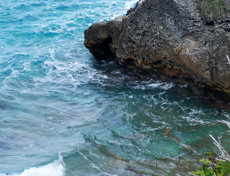
Tropical waters, like those here in Bermuda, are very clear because there are relatively few phytoplankton in the water. Plankton-rich waters are less clear and are usually green or brownish.
When you visit a pond or the beach, what kinds of living things do you see in the water? Depending on the environment, you might find fish, frogs, crabs, insects, seaweed, or lily pads. Don’t let your eyes fool you, though… there’s a hidden world in water that is full of creatures too small to be seen! When you go swimming in a lake or in the ocean, each stroke pushes you past billions upon billions of microscopic creatures called plankton.
It was a German scientist named Viktor Hensen who gave plankton this name. If you wonder why he used this name, it helps to know your Greek and something about how these tiny life forms travel. Planktos in Greek means drifting or wandering. Plankton are too small to swim in water in the same way fish or whales do… they simply drift along. This is why they came to be known as plankton.
What Are the Different Kinds of Plankton?
There are two main kinds of plankton: phytoplankton, which are also called algae, and zooplankton.
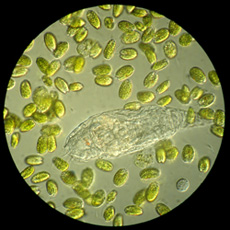
A rotifer (a type of zooplankton) swims through a group of phytoplankton cells in this microscope image.
Phytoplankton are like plants. They use energy from sunlight to turn carbon dioxide, a gas in air and water, into sugars they can use to grow. Because they depend on the sun, phytoplankton can only live in the upper parts of a lake or the ocean. In deeper, darker waters, there just isn’t enough light for these creatures to grow and survive.
Zooplankton, the other kind of plankton, are tiny, and in a few cases not so tiny, animals. They must eat to stay alive. Some zooplankton graze algae just like cows munch on grass. Some are hunters that catch other zooplankton. And some zooplankton eat detritus—that means they eat dead organisms and poop sinking through the water!
How Small Are Plankton?
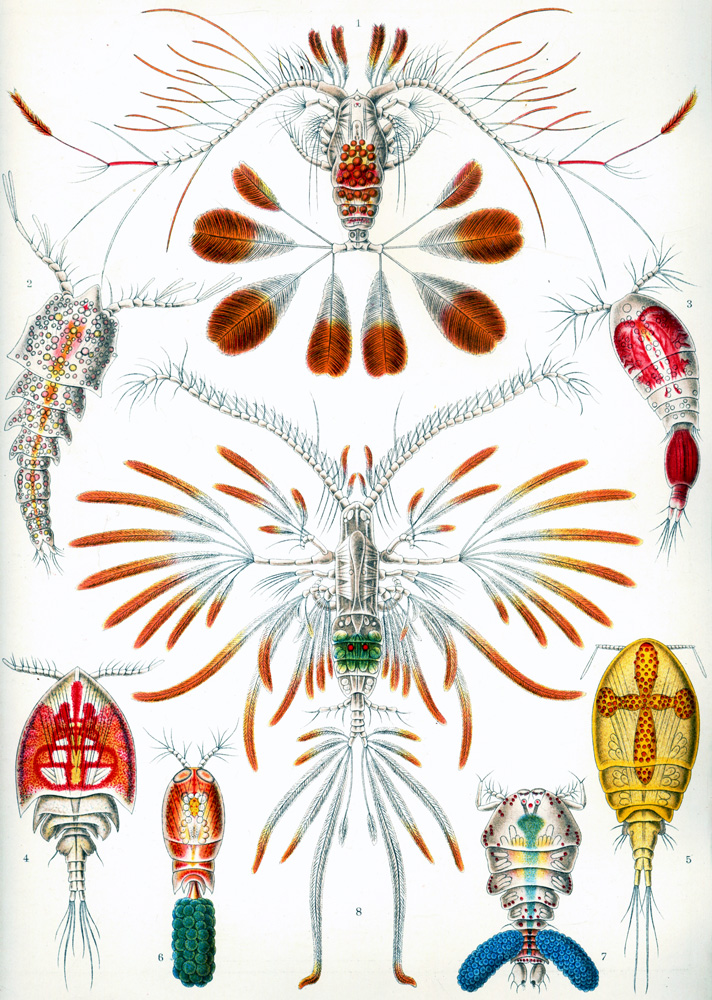
Like all life on earth, plankton come in all sorts of shapes and sizes. The smallest are the bacteria, which are much too small to be seen without a powerful microscope. Most bacteria are only a few micrometers wide.
Next are the unicellular phytoplankton and zooplankton. “Unicellular” means their bodies are made up of only one cell, like a cabin with just one room. (Although, sometimes unicellular creatures can form chains with others of their same species). Even though they may be ten to 100 times larger than a bacterial cell, you would still need to look through a microscope to see these organisms.
Some plankton are big enough to be seen with the naked eye. Try this the next time you visit a pond or lake: scoop up a glass of water and hold it up to the light. Unless the water is very dirty, you should be able to see small specks swimming around. These specks—the largest no bigger than a few millimeters long—are zooplankton. They’re probably the smallest animals you’ve ever seen!
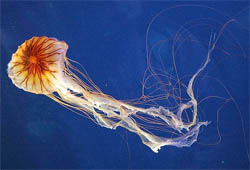
Did you know that there are giant plankton? Jellyfish are one type of megaplankton that you can see without a microscope.
Copepods are one kind of zooplankton. These tiny creatures are the most abundant organisms on earth! They even outnumber all the insects in the world.
Giants of the Plankton World
There are also giants in the plankton world called macroplankton and megaplankton. Krill and jellyfish are examples of plankton big enough to see without a microscope. These large animals actively swim, but their movements are still mostly controlled by ocean currents.
Little Creatures With a Big Impact
Even though there are giant plankton, most are microscopic. Without these tiny living organisms our world would be a very different place. Plankton can be found in almost any body of water. About 71% of our planet is covered by water. Since plankton are incredibly small, there are a lot of plankton on earth. In fact, you can find thousands of plankton in a single drop of water.
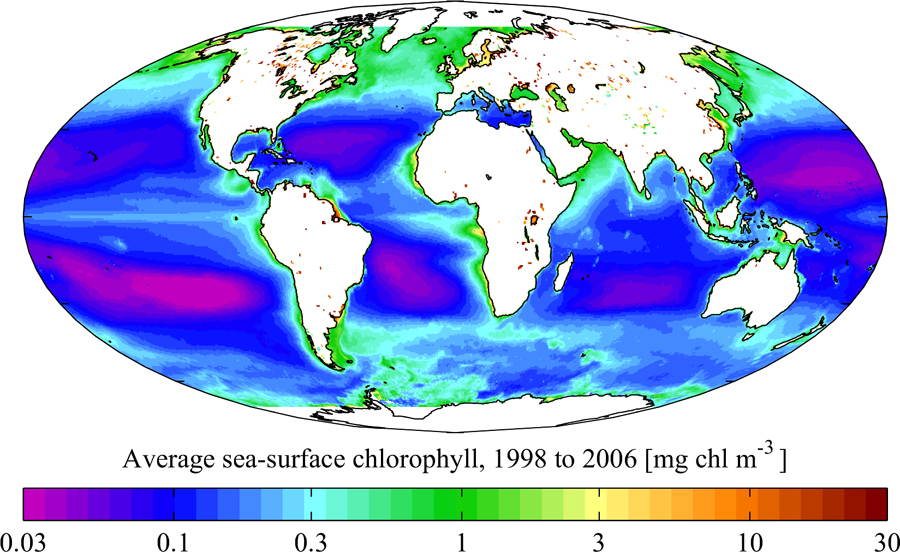
Like the plants you see around you, phytoplankton give off oxygen gas when they use sunlight to turn carbon dioxide into sugars. Half of the oxygen in our atmosphere was made by phytoplankton. Take a deep breath and think about how 50% of the oxygen you just inhaled was made by microscopic creatures.
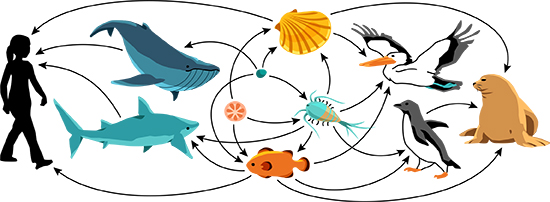
Phytoplankton also form the base of aquatic food webs. In other words, all life in the ocean ultimately depends on algae for food. Because algae can use the sun’s energy to transform air into sugars, they provide a rich supply of food for the zooplankton and other creatures that eat them. Those zooplankton are eaten by larger zooplankton, by shellfish, by fish, and by baleen whales. Little fish are eaten by birds and bigger fish, and so on throughout the tangled food web. Sea lions, penguins, sharks, killer whales, dolphins… all of these animals ultimately depend on plankton to survive!
This section of Ask A Biologist was funded by NSF Grant Award number 0752592 and 1030345.
Read more about: An Invisible Watery World
You may need to edit author's name to meet the style formats, which are in most cases "Last name, First name."
https://askabiologist.asu.edu/explore/plankton
Bibliographic details:
- Article: An Invisible Watery World
- Author(s): Amy Hansen
- Publisher: Arizona State University School of Life Sciences Ask A Biologist
- Site name: ASU - Ask A Biologist
- Date published: 18 Apr, 2011
- Date accessed: 16 June, 2025
- Link: https://askabiologist.asu.edu/explore/plankton
APA Style
Amy Hansen. (Mon, 04/18/2011 - 14:57). An Invisible Watery World. ASU - Ask A Biologist. Retrieved from https://askabiologist.asu.edu/explore/plankton
American Psychological Association. For more info, see http://owl.english.purdue.edu/owl/resource/560/10/
Chicago Manual of Style
Amy Hansen. "An Invisible Watery World". ASU - Ask A Biologist. 18 Apr 2011. https://askabiologist.asu.edu/explore/plankton
For more info, see http://owl.english.purdue.edu/owl/resource/717/04/
MLA 2017 Style
Amy Hansen. "An Invisible Watery World". ASU - Ask A Biologist. 18 Apr 2011. ASU - Ask A Biologist, Web. https://askabiologist.asu.edu/explore/plankton
Modern Language Association, 7th Ed. For more info, see http://owl.english.purdue.edu/owl/resource/747/08/
Above is a young polychaete worm. Learn more about this and other plankton in this video.

Coloring Pages
and Worksheets

Puzzles

Experiments
and Activities

Listen
and Watch
Be Part of
Ask A Biologist
By volunteering, or simply sending us feedback on the site. Scientists, teachers, writers, illustrators, and translators are all important to the program. If you are interested in helping with the website we have a Volunteers page to get the process started.
