Sel Tubuh Kita yang Berbeda-Beda

Ayo kita berpetualang ke dalam tubuh. Jika kamu menyusut menjadi sebesar sel dan diangkut ke dalam tubuh, di manakah kira-kira kamu akan mendarat, ya? Nah, salah satu cara untuk mengetahuinya adalah mencari tahu jenis-jenis sel yang spesifik. Manusia memiliki sekitar 200 jenis sel yang berbeda. Mari kita simak dua contoh berikut ini: sel otak dan sel darah.

In this episode, we begin to explore the wild and fascinating world of zoos. Our guest is none other than Bert Castro, the President and Chief Executive Officer of the Arizona Center for Nature Conservation. Bert's storied career, beginning as a volunteer zookeeper at the Tulsa Zoo in 1985 to CEO of the Phoenix Zoo, has given him a wealth of knowledge and experiences which he shares with Dr. Biology. We explore the importance of zoos, and the vital role they play in research and conservation, and discuss the intricacies of running a modern zoo. Can you guess how much AZA zoos and aquariums contribute every year toward conservation efforts?  Tune in to find out.

And... this is one of three episodes we recorded at the Zoo. Be sure to subscribe to the podcast so you do not miss our next fun and interesting guests.

Learn more: Keeping Your Cool - Thermoregulation
Visit the Phoenix Zoo

If you have not already, please subscribe to the podcast so you can be notified about new episodes.


Chronicles of a Zookeeper

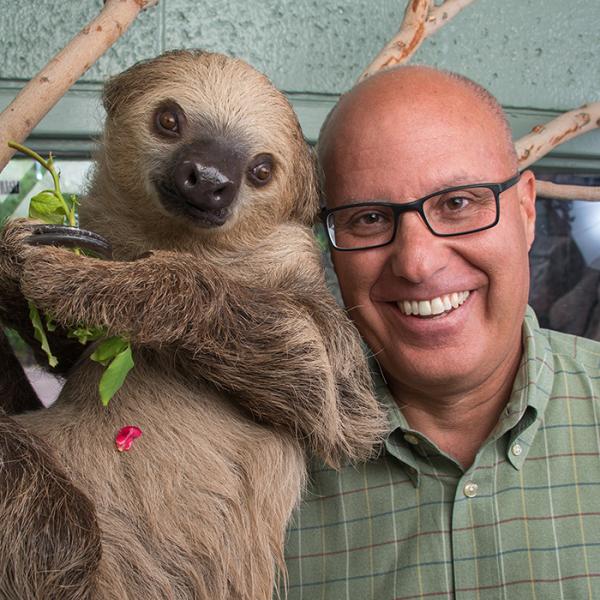
Bert Castro with a sloth at the Phonenix Zoo

Dr. Biology:

00:00

This is Ask A Biologist, a program about the living world, and I'm Dr Biology. For today's episode, we're getting out of the studio and into the wild. Well, maybe not the wilderness type of wild, but certainly a place where you can see thousands of animals. Yes, we're off to the zoo, and not just any zoo. We are visiting the Phoenix Zoo Now. We may not be able to see all 3,000 animals today, but we will get an introduction into the world of zoos why we have them, what they do for us, and the animals that live at the zoo. 

00:46

My guest today is Bert Castro, the President, and CEO of the Arizona Center for Nature Conservation, which is the group that operates the Phoenix Zoo. Bert's career started in 1985 when he was a volunteer and then, later that year, a keeper at the Tulsa Zoo. He has since then served in many roles at several zoos, including ones in Atlanta, San Antonio, Oklahoma, and now the Phoenix Zoo. For Ask a Biologist, we’re excited to be here because we often get questions from people wanting to work at a zoo. They love animals and they want to find out a way to work with them. Now, this episode is one of a three-part series we're doing about the zoo, and we plan to have other fun and interesting guests to follow. So, before anyone or any animal gets too excited, let's dive in and start exploring the world of zoos. Welcome, Bert, and thank you for sitting down to talk on Ask A Biologist. 

Bert:

01:58

Thanks for having me. 

Dr. Biology:

01:59

Let's get started. We're at the zoo and it's huge. How big is the Phoenix Zoo compared to other zoos? A lot of people hear about the San Diego Zoo. 

Bert:

02:09

You can measure a zoo on different levels. You can measure it by the size of its acreage. You can measure it about the size of its budget, but if you look across all AZA, which is the Association of Zoos and Aquariums, we're probably in the top 10 in terms of how large we are. We sit on 125 acres. The San Diego Zoo sits on 90 acres. The difference is the San Diego Zoo has a collection of about 6,000 animals and we have a collection of about 3,000 animals, so we're a little bit more spread out than the San Diego Zoo, but all in all, we're a very, very large, complex zoo. 

Dr. Biology:

02:47

Right, and that's one of the things I've always noted. There are areas in particular, I think, about the giraffes, the habitat for the giraffes. I mean, if I got to be in a zoo and I'm a giraffe, that looks like an amazing place. 

Bert:

03:01

Yeah, it's a five-acre exhibit and I've been to Africa on many occasions and have been out on the savanna and when you walk up to our exhibit, they did a really good job of putting that exhibit together. It's very large, spacious. We have a variety of species in that exhibit and, you know, it allows the animals to kind of do their own thing and have an enjoyable time in that exhibit. 

Dr. Biology:

03:26

I agree. It's just a fantastic habitat. There is one that I've always wondered a little bit about, and that's the one for the bald eagle. Typically, you think of an aviary where it's big enough for the birds to fly, but this is not big enough for a bald eagle to fly, and I was always curious why that kind of a habitat. 

Bert:

03:46

Yeah, we have a couple of bald eagles in that exhibit and you know, the interesting thing is they are not flighted birds. Those are actually rehab birds that can't fly. So even though the exhibit is probably 15 feet by about 30 feet in length, which seems small for bald eagles, it's actually quite appropriate because they cannot fly. 

Dr. Biology:

04:10

Oh, okay, that makes sense. I did not know that. 

Bert:

04:14

We probably should put a sign up to let our guests know that. 

Dr. Biology:

04:18

Well, to be fair, maybe that sign is there and I missed reading it, but it's something for people to think about when they see some animals in habitats that they think maybe aren't big enough for them. It could be for this very reason. So, the next question I'd like to tackle is what should a good zoo be doing. 

Bert:

04:39

Gosh, that's a really good question A good zoo there are good zoos in my opinion, and there are bad zoos. Let me start off by saying there are about 2,500 to 3,000 animal exhibitors in the United States, of which only about 9 or 10% are accredited AZA zoos. And you know, a great zoo has wonderful education programming. You know, at the Phoenix Zoo all our educational programs are aligned to Arizona State standards. So, we want kids to come out to the zoo and have a wonderful time, but we want the science that they're learning to be applicable to the classroom so that when they go back to the classroom they're learning something. And so that's an example of great education and an accredited zoo. 

05:30

Good zoos are conservation centers. 

05:34

They're places where we're working very, very hard on a daily basis to save animals in the wild. 

05:41

Many people don't know this and it's kind of interesting. We've been really good as zoos, in general, to talk about the fun things you can do at a zoo in terms of just a great, wholesome place to bring your family and have a great recreational outing. What I think we've done poorly over the years as a zoo community is not really talk about our mission like we should, and so a lot of people don't know that this last year, zoos and aquariums AZA zoos and aquariums contributed over $250 million to research and conservation around the world. So, every year over $200 million gets poured into conservation so the money that we make from people who come out and enjoy the animals. Many people won't ever have an opportunity to go to Africa to see giraffes in the wild, but they have an opportunity to come to the zoo and our hope is that through our education programs, through our conservation programs, people walk away from the zoo with a better appreciation for wildlife and a better appreciation for nature as a whole. 

Dr. Biology:

06:55

Right, and I think that makes a lot of sense. Some of the people that will have not the best view on zoos. They're thinking about the animals. I think the animals are actually. 

Bert:

07:09

They feel like they're maybe in jail or they're you know, they're not, yeah biologists think at least from my perspective we think about the species and the survival of the species, whereas other groups think about the individuality of the animal and how is that animal being treated? You know, through our accreditation process we have very, very rigorous standards on how we maintain, exhibit, and take care of our animals, much different than, say, a roadside zoo. But I think one of the biggest problems is certain people clump all zoos together, so sometimes the good zoos get a bad rap from the bad zoos, and so I think it's important that we continue to get our message out. We continue to work with other organizations so that there's a better understanding about what we do as a zoo community, and we've been trying to do that, as the association has been working with a variety of groups out there to find common ground to work to help wildlife. I think that's very important and hopefully, through better understanding, everybody gets to understand everybody better. 

Dr. Biology:

08:22

What I find interesting, and one of the future guests, will be your person that's in charge of Behavioral training. 

Bert:

08:30

Yeah, behavioral training. 

Dr. Biology:

08:33

And there was another term they used was enrichment. 

Bert:

08:37

Oh, behavioral enrichment yeah. 

Dr. Biology:

08:39

And I just thought that was great because I have seen the rhino playing, I have seen Hindu, the Asian elephant playing. They actually have lots of toys and I think about my new grandson and I'm thinking, wow, these elephants get toys, just like my grandson, and they seem to really enjoy playing with them. 

Bert:

09:00

Yeah, when I started in this business some 38 years ago, behavioral enrichment really wasn't a thing, and so it was really about, okay, how do we keep these animals alive, how do we keep them healthy? But in terms of their psychology, in terms of really keeping them in appropriate environments that are good for them, that's been a slow progress in zoos over the last 15 years or so, maybe 20 years. So, it's important to make sure that not only the animals have the appropriate space, but they also have things to do. You know, it's easy for animals, especially intelligent animals, to get bored, and so when I was a keeper, I spent my eight hours a day working, doing projects, cleaning. Now, our keepers today probably spend a third of their day doing routine and the majority of their day working with their animals to ensure that they're having the best possible life that they could possibly have. 

Dr. Biology:


10:02

Right, and you know, when we talk about that, one of the things that's going on right now for all animals, including humans. We're in the Phoenix area and the temperatures have been just unbelievably hot. For now over 20 days, over 110 degrees Fahrenheit. What are we doing at the zoo for the animals and again for all animals, I mean going to the zoo. If I was going to go to the zoo, that's going to be pretty tough as a human, but the animals too. What are we doing with this heat? 

Bert:

10:35

Well, as everybody knows, we're in a desert, and so the animals that we keep at the Phoenix Zoo are animals that are found in warm climates. You won't see a polar bear at the Phoenix Zoo, so that's one thing we do. We have animals that are found in desert areas, in tropical areas. We also do a lot with shade, with misters waterers, and we give animals a choice. So, when it gets blisteringly hot, we give them a choice to either stay outside if they want or to go inside where there's air conditioning if they want. So, we give the animals the ability to make up their minds. 

11:15

Sometimes I'll walk out in the zoo. It'll be, you know, 105 degrees and you know the animals are outside because they prefer to be outside. A lot of our African animals love the heat, but when it gets really, really hot like it's been these last few weeks, we make sure that the animals have everything they need and the ability to go inside. One thing we did was close the zoo down earlier. We felt that that was important not only for our animals but for our guests. We were finding our keepers were struggling in the heat. Our guests were struggling. We weren't really seeing our animals struggle as much, but we wanted to make sure that we keep everybody safe while they're in the zoo. 

Dr. Biology:

11:59

Right, you start early hours right? 

Bert:

12:01

We do. We open the gates at six in the morning for our members, seven o'clock in the morning for our regular guests, and we are now closing at 11. It used to be one o'clock, so through the month of July and August we'll close at 11. 

Dr. Biology:

12:15

Right Makes perfect sense. You talked about your keepers and actually, your career is really a fascinating one because you've done I wouldn't say you've done it all, but you've done a lot of different roles in the world of zoo management and zoos. So, let's talk a little bit about life when you're working at a zoo. What's it like? 

Bert:

12:38

Well, it's all I know. It's all I've done in my entire career. Shortly after college, I started sending resumes all over the country and I would get these little thin letters that said thanks but no thanks. Congratulations on getting your degree. But you had no experience and so I ended up volunteering at my local zoo and there was a job that nobody liked to do and I said I'll do it and we had a mammal building there and down in the basement. At that time we had about 2,000 feeder rats and mice and my job was once a week I would come in on Saturdays and for eight hours clean the rat and mice cages. So, that was my start in Zeus. You know I did that for almost a year and I think a couple of positions opened up and they said well, you know what this guy? He's dependable, he shows up, he does the dirty work, he's a pretty good guy and they hired me as a zookeeper and I've been in Zeus ever since. So, I was a zookeeper for about eight years at the Tulsa Zoo. 

13:47

While I was there I went back to a small university in Wichita, Kansas, that offered an adult program in environmental studies with an emphasis in zoological administration. I did an internship at the Sedgwick County Zoo while I was still working at the Tulsa Zoo, and then from there, I went to New Orleans. I went to the Audubon Park Zoo as an assistant curator, spent a few years there, and from there on to Zoo Atlanta in Atlanta, Georgia, as a curator of birds and mammals, and then from there I took a general curator job at the San Antonio Zoo, and that's really where I learned how to not only take care of an entire animal collection, but I really learned a lot about the business side of zoos. As a biologist, I came up through the animal ranks and did know a whole lot about what it would take from a business standpoint to run a zoo, and so I learned quite a bit there. 

14:43

From there I went to Oklahoma City as executive director at the Oklahoma City Zoo, and that was a. It was a public non-profit. So, I had a board of nine individuals six of them came from the private sector, three of them were the mayor, the city council person, and city manager and so spent about seven years there. And then I came to the Phoenix Zoo. It's a non-profit zoo, a 501C3, which was much different than the previous zoo I was at. That zoo received a 1-8th penny sales tax. That generated quite a bit of money for the zoo. The Phoenix Zoo, being a non-profit zoo, receives no public funding for its operation, so it's run much differently, and I've been at the Phoenix Zoo for about 15 years now. 

Dr. Biology:

15:32

So, if someone wants to get started in the world of zoos and let's pick a student, let's pick one of our students that sends questions to us. It's usually a middle school or high school student that says I love animals and I've always wanted to work at the zoo. What's the best career path for them to go on? 

Bert:


15:56

So, from a biologist's perspective right, because now zoos are so complex we've got accountants, we've got development people, we've got marketing people, pr people there's so many facets to running a zoo nowadays. So, we have a lot of people that are not biologists but are critically needed to help us with our mission. But if I'm talking to somebody who wants to be a biologist, I say, first of all, stay in school, get your degree. It's so competitive. You know, we were hiring for a position a few months ago and we had about 150 applicants for the position, many of them with master's degrees, applying for a front-line keeper position. So, it's extremely competitive, much more competitive than I think it was when I became a keeper. And so I would say stay in school and if there's any way, you can get experience. That's key because school is great and you learn a lot at school. But having that hands-on experience will just help you in the long run, especially when you're trying to get that job. 

Dr. Biology:

17:03

The zoos. To me, one of the amazing things is to spend time observing the animals. Why I find that interesting is I often wonder if the animals are also observing me, In particular some of them, as you say, some of the more intelligent animals. I really have always wondered if they're spending time looking at me, and the only reason I'm asking you this kind of a crazy question because obviously, you're not in the mind of animals is have you ever had that feeling when you're walking around the zoo, that they get to actually know you? 

Bert:

17:42

They do. And as a keeper, you can be standing out there with 200 people and you'll walk in the midst of those people and that animal will pick you out and you know, it knows you. And it was quite interesting during COVID, you know, we had to close down for 161 days. Covid was tough for everyone. What we saw with a lot of our animals mostly our primates, a lot of our petting zoo animals, you know, our domestic goats was that they really missed seeing people, and so our keepers were actually spending more time with the animals. They'd go down to the exhibits and have lunch with the animals, because the animals at least, you know and this is anecdotal, this is not, you know, research by any stretch but we felt that the animals missed seeing people and we saw that, without being too anthropomorphic, that they were down a little bit, you know, and that having that connection was good for them, as well as with our keepers. So, I'm with you. I think animals do know who you are and they can certainly pick out individuals and they're very, very intelligent. 

Dr. Biology:

18:55

I actually was fortunate earlier before you and I got to take some time out to talk. I met Indu, the Asian elephant, and she gave me a rock with her trunk. She picked it up and handed it to me. The caretaker was there, by the way, I wasn't breaking any rules and it was interesting because she told me that's a present. 

Bert:

19:21

That is a present, and she doesn't do that often Wow. You must have impressed her in some way. 

Dr. Biology:

19:29

I guess, did impress me, and I'm pleased to know that that was something special, because that felt special to me. Alright, so if it wasn't so hot, we could be wandering around the zoo and doing more talking rather than just being isolated in one place. But we're just like the animals. We have to regulate and, by the way, thermal regulation is the term we use so that you can be cool when it's hot and warm when it's cold. Animals have to do the same thing. We have a podcast about thermal regulation. So, along with animals, do you have a favorite animal, or maybe a couple favorite animals? 

Bert:

20:12

I do. I love elephants. I was an elephant keeper for many years and everything they say about elephants about them being so intelligent and smart is exactly true. They're just amazing animals and just incredible to work with. I also have an affinity for jaguars. 

20:30

We have been working on a long-term project in Costa Rica. Dr. Jan Skipper, who's an associate professor here at ASU and was also our director of conservation, has been doing a lot of work there On a jaguar corridor. There's in southern Costa Rica there's an international park called La Amistad International Park, and then down by the Osa Peninsula about 30 miles away, there's another smaller park and there's a very vibrant population of jaguars in the very large park, and a stagnant, so to speak, a very bottlenecked population in the Osa Peninsula, and so we have been working with their government, farmers, landowners to build a wildlife corridor, to allow the jaguars and other wildlife to utilize a corridor so that jaguars can move back and forth because the land is so fragmented, the animals can't move from one park to the other, and so we've been working on that project for quite some time and I've been down in Costa Rica and had an opportunity to work with Dr. Skipper and it's just such a cool project and I've learned a lot about jaguars, so very cool animal. 

Dr. Biology:

21:45

Right yeah, animal corridors. It's a really good topic because a lot of times we don't think about it as humans. We build these freeways, we build walls, we do all sorts of things not thinking about the animals that might use that as their normal passageway. And while humans can figure out how to get around obstacles, animals don't. And that's problematic unless you're a bird, and then you probably have half a chance of flying over those, but that's correct. 

22:13

That's really an interesting one. It also comes to the discussion about conservation is one of the things that AZA. They contribute to conservation. This also deals with threatened and endangered species. That's true, guys, and so this is another role that I put the good zoos into is the fact that it's not just to bring animals closer to humans so humans get the benefit. It's also how do you ensure the survival of a species through these conservation efforts. And if you go to even Wikipedia I think is one of the nice things about Wikipedia now if you go to it and you look on the right-hand column, you'll see that there is a ranking there that shows you what the status of that particular animal you might be looking into, and it'll tell you whether it's threatened or endangered or, in some cases, there are some that are listed that are extinct as far as we know. So, let's talk a little bit about how the zoos are working in this realm of conservation and dealing with threatened and endangered species. 

Bert:

23:24

So, ex-situ (off-site) working in zoos, we work through SSP programs, which are species survival plan programs. So, if you can think of it as maybe sort of like a pedigree, we have management committees that will focus on one species. To give you an example, today something came across my desk we have six African porcupines and the SSP. Once a year they make the recommendations for breeding. The whole idea is really trying to keep as much genetic diversity in the captive population as possible, and so we were asked to hold no breeding this year from our animals. But you know, they know everything about every animal in the population, what its health records are, what its genetic background is, where it's from, and we basically follow those recommendations. 

24:16

So, if they were to say, well, gosh, this certain animal who's been at your zoo for five years needs to go to Omaha to be paired with another animal, We'd immediately start working on making that transfer, because we're trying to sustain these captive populations. On the flip side of that, in terms of in-situ conservation, the AZA has developed a program called SAFE, Saving Animals from Extinction, and we have been I've been part of raising quite a bit of money for this program and it's really a way that we, as zoos and aquariums and individuals can work together to help save some of these species out in the wild. And so we've really kind of compiled our resources, have done a tremendous amount of fundraising, and then working with those researchers out in the wild and trying to support their efforts, their conservation efforts in the wild. 

Dr. Biology:

25:14

So, when I go to the zoo and I pay my entry fee or I'm even better I get my annual membership. Part of that money is going to these programs, that's correct. Yeah, that's great. It is great, that is really good. Well, Bert, before I let my scientists get out of here, I always ask three questions. I might modify the third one because we kind of covered it, but the first one is when did you first know you wanted to be a biologist and then when did you become very interested in working in a zoo? 

Bert:

25:53

So, my story starts when I was really young. My family immigrated from Havana, Cuba, and so we came to the United States. I was born there. We came when I was two years old and when I was about six my mother started taking me to the zoo. It was a free place to go to and it was a fun place for me to go. And I can remember at around age seven I had two of my dear friends who I went to school with. They had birthdays around the same time and we had a birthday party at the Tulsa Zoo. As part of that birthday party, we were able to go and meet Gundah the elephant at that zoo, and my mother tells me that when she came to pick me up she just said I just wouldn't stop saying that, Mom, I want to be a zookeeper. 

26:41

I didn't know what a biologist was. All I knew was I had this amazing experience with this giant animal that was so smart and I told her I wanted to be a zookeeper. Well, 17 years later, I became that animal zookeeper and that has been my love ever since. That's all I've ever done. Zoos are part of who I am and I've learned a lot. You know you go into zookeeping for the love of animals, and then you start learning about all the complex issues around animals and those issues are big issues and how do you work with other people to help these animals. And so I'm still learning. I've been doing this for 38 years. I'm still learning every day on how we can conserve and give these animals a better life in the wild. 

Dr. Biology:

27:29

Right, what was the name of the elephant? Her name was Gundah Gundah. 

Bert:

27:35

She just passed away, about a year ago. 

Dr. Biology:

27:37

Oh OK. 

Bert:

27:39

Yeah, she was, I think, 70 in her 70s, so it's pretty amazing yeah. 

Dr. Biology:

27:45

Right. Well, that's another thing that I've noticed that we do these virtual tours on biomes, and often there are animals part of that, these virtual tours, these VR tours that we go into and I'm always doing the research on the animals that we happen to have captured in these VR tours, and when they show life spans, it's in captivity versus in the wild. I have yet to find one that doesn't live a lot longer in captivity than it does in the wild, that's for sure. 

Bert:

28:17

I think you've got really good health care in zoos. You have no predators, so that probably has something to do with it. Yeah. 

Dr. Biology:

28:27

All right, so this is something you've done your whole life. I can tell you were basically imprinted by that elephant, which is really, really pretty cool, but I'm going to take it all away, for this question. So, your life in zoos is gone? Oh gosh, I know that's horrible. It's just a thought experiment here. We're not going to really take it away. Obviously. My question is what would you be or what would you do if you didn't have this? 

Bert:

28:54

career. The one thing in the back of my mind that I thought I would like and I was intrigued by but don't know a whole lot about, was wastewater management and I thought, gosh, how do you take all this really dirty water and get it to a point where people can drink it? But I thought about it for about a day or two and then get back to zoos. 

Dr. Biology:

29:17

And today this is a really important topic. 

Bert:

29:20

It really is. 

Dr. Biology:

29:22

Water is going to be key for many people around the world. Some will have too much and, like in the desert, we don't have enough right? 

29:32

The last question is typically what advice would you have for someone who wanted to start working in the zoos and pretty much covered that earlier on? So, I was going to ask you if there was something that you thought your young zookeepers forget to do or learn before they come, what would it be? What would be the thing that you would say will serve them well in their career that they may not be doing because they just don't think about it. They've done the usual stuff and there's something they're just not thinking about. 

Bert:

30:17

You know, the thing I had to learn as a zookeeper was to be detailed, and what I mean by that is that when you're working with wild animals, it's important to be detailed in terms of how you take care of them, in terms of how you clean for them, in terms of safety, lock safety. You have to really be attuned to those animals and be attuned to what you're doing on a daily basis, because a lot of what keepers do is very redundant. I think the animals like that redundancy, they like routine, they're familiar with it, even though, you know, from a visitor's perspective, a lot of visitors come to the zoo and they say, oh gosh, that zebra looks so tame and it's a wild animal. And so it's important, as a zookeeper, to know that you have to be very detailed in what you're doing for your safety, for the public safety and for the animal safety. 

Dr. Biology:

31:15

Right, okay, for the young zookeepers out there that might have their pets at home, you could start your own project on that by creating your own log sheet to make sure when you feed them, how often you feed them. 

Bert:

31:29

Clean that litter box. Clean that litter box. Yes, yes. 

Dr. Biology:

31:33

I will triple agree with that one there, one who has cats and loves them dearly. Well, on that note, Bert, thank you so much for visiting with me. On Ask A Biologist. 

Bert:

31:45

Thank you so much. I really appreciate you having me here. 

Dr. Biology:

31:49

You have been listening to Ask A Biologist and my guest has been Bert Castro, the President and CEO of the Arizona Center for Nature Conservation, which is the group that runs the Phoenix Zoo. For those that live in the Phoenix area, I hope this podcast has you thinking about going to visit the zoo. Just remember, if it's in the summer, do it really early in the morning, and we'll also include a link to the zoo in the show notes so that you can get all the details about parking and other things that you might need to know for your visit. Keep in mind this is the first of a three-part series and if you have not subscribed to the Ask a Biologist podcast, you might want to do that right now so you don't miss the other really fun and interesting guests we're going to have on the show. 

32:44

The Ask a Biologist podcast is produced on the campus of Arizona State University and is recorded in the Grassroots Studio housed in the School of Life Sciences, which is an academic unit of the College of Liberal Arts and Sciences. And remember, even though our program is not broadcast live, you can still send us your questions about biology using our companion website. The address is askabiologist.asu.edu, or you can just use your favorite search tool and enter the words Ask A Biologist. As always, I'm Dr Biology and I hope you're staying safe and healthy.

Be Part of
Ask A Biologist

By volunteering, or simply sending us feedback on the site. Scientists, teachers, writers, illustrators, and translators are all important to the program. If you are interested in helping with the website we have a Volunteers page to get the process started.

Donate icon  Contribute

Share

We hear a lot about DNA, but not as much about RNA. It is true that DNA is the encyclopedia of life or the ultimate instruction manual for living things. But what good is a book if it is not read or an instruction manual that is not used? This is where RNA comes into the story of life. It is the unsung hero, or maybe the superhero of cells. Dr. Biology has the opportunity to sit down and talk to a big fan of RNA. Computational biologist, Brandon Ogbunu talks about his early work, which he titled The Liberation of RNA, and much more in this very fun and thought-provoking episode.

Learn more about: Brandon Ogbunu
Learn more about: Cells


If you have not already, please subscribe to the podcast so you can be notified about new episodes.

Making Life Happen

Podcast guest Brandon Ogbunu

Dr. Biology:

This is Ask A Biologist. A program about the living world. And I'm Dr. Biology. On this podcast, we talk a lot about DNA - deoxyribonucleic acid. It seems to grab our attention because it stores all the information about living things. It is the ultimate instruction manual, packaged in an unbelievably small size inside almost every living cell. But DNA is only the start of the story of 'life' because it needs something to actually help build things and give instructions to do the work inside living organisms. It needs RNA - ribonucleic acid.

Our guest today is a big fan of RNA and he is also a scientist who has a storyteller writing for Wired magazine The Atlantic, as well as other publications. And I found out yesterday he is a fan of history. Brandon Ogbunu is a professor at Yale University. He's a computational biologist who spends his time researching ecology and evolutionary biology. His work explores a wide range of areas, including the causes of disease. His career path and his numerous accomplishments are worth a visit to Wikipedia, and we'll include a link in the show notes. So, you can read about them.

Today, we're fortunate to have him in the studio because he is visiting ASU to give a talk titled “Interactions versus Everything Complexity, Disease, Contact Genes (and the space in between). I'm looking forward to our conversation and I hope we learn a bit more about the story of RNA. We might even get into some wordplay in this episode.

Welcome to Ask a Biologist. Brandon, I really appreciate you sitting down and talking with us.

Brandon:

Dr. Biology Great to be here. Thank you for having me.

Dr. Biology:

Let's just start off with the big question. We talked about DNA and more importantly, RNA, but not about the important job that RNA has in cell function and the evolution of life. So, can we talk a little bit about RNA? Can we set the stage? So to speak, as a storyteller?

Brandon:

Yeah. And to this, you know, I hearken back to my undergraduate thesis, right, which is entitled The Liberation of RNA, which some of you have become familiar with. And part of the reason why I called it that when I was in college and part of the reason why I think about RNA in that way is because you think about the way we talk about certain aspects of biology in life. 

And I feel like DNA has always been center stage. Everybody loves DNA. Your DNA is on the marquee at the show. DNA feature in DNA. DNA is on the cover of the magazine. Everybody knows DNA. And I feel like RNA has been this kid sibling that hasn't quite gotten the attention it deserves. And I think the good news is, in the last 20 years, that's begun to change. People now understand what makes it so powerful and important because we have a new understanding now of the way information works in life.

Dr. Biology:

Right. You know, you go back to your DNA and I said, you know, it's an instruction set, it's an encyclopedia. But if it sits in the library and never gets used, what good is it? So here we bring in RNA and messenger RNA, and they're actually doing the work.

Brandon:

That's exactly right. So, like long-term storage DNA is powerful. And you know what? I'll go ahead and say it. DNA, I think, is the most powerful and important piece of information in the universe. So, I’m not against DNA. I'm on its team. I love it. I'm with it. There’s a reason why It's the basis for all cellular life on Earth that we know of at the moment because it does this remarkable job of encoding this information, but by itself, it just sits in the cell and doesn't do anything. 

We think about the exciting and dynamic process of the way a cell works and the way a person works and the way a plant works and the way a microbe works. That's because biology is dictated by turning things on and off at very particular times. From the breakfast that you ate to the dinner that you eat to sleeping and walking, it requires that you turn genes on and off in these very, very rapid ways in response to the world that we're living in. And RNA is really a very critical component to taking that information in DNA and actualizing it and animating it. Right. So, that we can actually do these things. 

Dr. Biology:

Right. For example, RNA is out there, but especially messenger RNA goes out working with ribosomes. What are we going to do? We're going to make things right. We're going to make some proteins without those proteins, without those signals, without those things that are going throughout your cell and then outside of your cell to the rest of the organism, whether it be a human, a cat, a plant, you know, fungi, whatever you want to talk about, without that, it all stops.

Brandon:

Yeah. So, when we think about the flow of information from DNA to RNA to protein, and you might have seen a picture where you have DNA with an arrow to RNA with an arrow to protein. We call that the central dogma of molecular biology. And really all it means is just a picture that tells you how information flow happens in a cell. And so protein is another one that's gotten a lot of attention. You know, we know about protein from our diet. They're actually doing the work in the cell. They're the ones that are actually breaking down the sugar in your diet. And they're the ones that are doing a lot of the heavy lifting physically in a cell. 

So, we know them. RNA has been caught in the middle, and that's one of the reasons why it's been underappreciated. And part of the reason why it's under-appreciated is that like messenger RNA, it, relatively speaking, short-lived DNA is engineered to last a long time. That's why it's the basis of heredity. RNA on the other hand is relatively short-lived. It does its job; it provides instructions for proteins to make typically and has other functions as well. But the main one is messenger RNA is basically saying, hey, this is what we need to make protein-wise, let's make it. And then RNA disappears. Right.

Dr. Biology:

Unsung hero.

Brandon:

That's right. You don't see it, even though it's responsible for all the things that are happening.

Dr. Biology:

That's when it's doing everything. Well, let's say as according to plan. But sometimes things don't go according to plan. And that's where we talk about mutations. And I always have to say this when I bring up the word mutations, a lot of people have a very negative view of mutation. The reality is mutations are both good and bad, and sometimes they're just they don't do anything. Let's talk a little bit about mutations and evolution because actually, those mistakes were important.

Brandon:

Oh, I mean, it's like a lot like life, right? I think to make any discovery of anything you want to meet a new friend, you can identify a new recipe that you like. It's oftentimes because you didn't have what you needed it. You tried something else, but you put some applesauce in your pasta by mistake and all of a sudden you got a special new recipe. And I think biology works the same way. 

Mutations, the vast majority of them do nothing. We think they don't actually bother anything. When you get one of these kinds of changes in your DNA, for example, we don't notice them at all. Mutations are happening all the time in our bodies, and we don't notice them because they don't have an effect. But a small fraction of mutations can do one of two things. They can cause problems, right? They can cause errors, or occasionally they can actually do something like we talked about with this apple pie. You know, with this pasta. They could actually do something good. And those are a very small fraction of them. So, this is why studying mutations is so critical is they're responsible for a lot of problems. 

So, for example, genetic disease is caused by mutations in DNA that is then transcribed into RNA that often gives you proteins. So, you might have heard of sickle cell anemia, for example, which is a disease caused by a mutation in hemoglobin [found in blood]. Right. A very important protein. But sometimes evolution works because it identifies a novelty, a mutation that allows you to do something different or better, right? Or allows you to kind of survive a condition that's very, very challenging. So, we shouldn't look at mutations as all negative. It's just kind of a change. And depending on where you are and what context you're in the world you're in and where you're occupied, it can be good or bad, right?

Dr. Biology:

And when you talk about mutations, they have to have some kind of final form that actually is still functional. And the reason I bring that up is you're introduced - we're at a lecture at a major university with a roomful of scientists and you introduce a word game. I had not played this game. I have to admit it was really interesting because it's you know; it's called the Ladder game or some people might know it as doublets or word links. 

And what was interesting about that is it really made it clear that you could make changes in this game. But they have to be changes with meaning. So, let's talk a little bit about this word game and mutations and how this becomes so important when we're doing our science and we're looking at how biology works.

Brandon:

Yeah, I mean, I think there's many important lessons in this word game. I first read it from one of my scientific heroes in evolution who used this word game to describe how evolution happens little bit by a little bit. And that's important for a bunch of reasons. This was a fancy, smart mathematician, a biologist named John Maynard Smith, and instead of using fancy mathematics, he used this word game to explain a critical concept.

And so I borrowed that as a way to talk about my science. You never want to talk about it any more complicated than you have to. Sometimes, you know, you have to actually use the math because you're talking to mathematicians. So, you try to make a particular point. And if you talk about RNA, sometimes you have to talk about kind of, you know, you know, individual atoms depending on who you're talking to, but not even sometimes you can actually describe things in basic terms. So, what he said was this you take the game word ladder where the idea is you start with a word and let's just say word w-o-r-d, right. 

And the goal of the game is to take this word and go to another word, changing one letter at a time. So, you have w-o-r-d and I want to change that to g-e-n-e and gene. Now, those are different words. The question is, how do I get from one of these words to the other changing one letter at a time? And what he said is and this is the way evolution actually works, how mutations work is you can identify steps that gets you from word to gene. One letter at a time. Where all the words in between make sense. So, for example, we can go from word to wore, change that D to E to wore to gore. Right? g-o-r-e, gore to gone g-o-n-e. And then you flip that o to an e, you get g-e-n-e. 

And those are mutations that do that. And like I said, just like with some mutations, some mutations you're talking about word w-o-r-d, maybe the first mutation is, I don't know, you know, gord and you know, in American English, right? That's not really a word we use. Not really. You know, maybe sometimes, but like, not really. You know, that's not like a common word, g-o-r-d. That'd be a mutation that gives us a mistake. Doesn't help us either. Doesn't help us or even maybe harms us. Right. 

So, there's a lot of mutations that aren't helpful, but sometimes you find that w-o-r-d to wore, and that now makes sense that next word makes sense. And so evolution works by moving step to step such that each of those individual words make sense. And those mutations mean genes that makes sense are RNAs that make sense and proteins that make sense. And using an algorithm like that, using a tool like that works like the word game evolution could come up with all kinds of new solutions for problems.

Dr. Biology:

Right. And I'll actually leave the audience with one to play with. They can start with cells. Right. And try to end up with human.

Brandon:

Oooh...

Dr. Biology:

Okay, how many? Not going to give an answer here. You guys can try it out.

Brandon:

That’s a good one.

Dr. Biology:

Okay. That makes a lot of sense. So, if you have a mutation that doesn't do anything, fine. But most importantly is you need to have something that doesn't basically cause enough harm that the cell can no longer function. So, I mean, basically, we're talking about back to the words. The words had to have some meaning. They have to still work. I love that. 

So, you're a storyteller. And I suspect that in the world of evolution because that's where you, your view on the world comes from that perspective. But you're a storyteller. Are there some unexpected plot twists that you have seen past, present, or future phases of evolution? Let's talk a little about those unexpected twists.

Brandon:

Mm hmm. Mm hmm. Yeah. I think the great thing about evolution as a science and I think the challenge of evolution of a science is that there are rules that govern the way things evolve. Right. We understand, like I just told you about the word game, right? There are things that we can understand about what the rules are, how mutations happen, what the rate of mutations is, for example. And we can describe evolution and populations of things. So, we have a lot of fancy and smart rules and tools to understand [how] evolution works. But the beauty of it is that it's nothing but surprise. 

I can't tell you for sure what's going to happen with a given species of bird. There's a lot of things that I have to learn and understand about the world in order to be able to make a prediction, right? So, evolution is full of surprises and, you know, there's an old analogy, right? Like they say that if you replayed the tape of life is and you started it over again, you would get a completely different set of solutions. Maybe we may not be here, or we would look completely different. And that's what makes evolution so exciting. 

It's a story of surprise and kind of like drama and excitement. And so, I think it's full of it. I think we see it everywhere. We think about even serious things like COVID-19 pandemic, for example, right? Which, you know, was such a serious, serious thing and a lot of other diseases. And being able to understand, for example, how those populations went from Beta to Delta to Omicron, I think Omicron in particular was a very, very surprising one because Omicron acquired all of these different mutations that did not exist in the Beta strain or the Delta strain or the original strain 

And that was very, very surprising to us. And I think we're still trying to understand how that happened. And we do have some ideas about going back to HIV. Right. Which, you know, of course, was a major, major problem. Part of what made our understanding of HIV so important from an evolutionary perspective is not only the origin of it, which was a big, big mystery. Where it came from is related to a virus SIV. Right. Simian immunodeficiency virus. 

But the reason why we've been able to treat HIV effectively is because we identified combinations of drugs that actually make it very difficult for HIV to evolve. So, by understanding evolution, we now can engineer drugs to prevent resistance, and that's helped a lot of people live a lot of healthy and happy lives. And I think it's a triumph of this kind of science. So, I think that's the beauty of evolution, is there's so much surprise in it. It's all these glorious things. It's responsible for the diversity of life and all the beauty and the plants that we see and the beauty in the animal species that we see. 

But it's also responsible for a lot of the problems that we're having. And even though it's surprising, there's a lot of things that are hard to predict, there's still rules that we can learn that can help us understand it, to help treat disease and perhaps even understanding how we'll respond to things like climate change.

Dr. Biology:

Climate change. How is evolution going to have an impact on climate change?

Brandon:

Yeah, So I mean, I think climate change describes a whole host of global changes that are going to happen in a lot of different places. So, it won't look like one thing in one place. But for example, you take the, you know, the term global warming. Let's just say in some setting you're going to have higher average temperatures than you would have. Right. We now know because of the way the world works, because of warm places, the types of adaptations that organisms have to have in order to be successful in warm climates. 

We know how cells evolve. We know how bird feeding evolves. We know how diets evolve in high temperatures versus cold temperatures. We know that. And so, we can begin to think about, okay, so maybe now we'll see more adaptations. So, for example, in a hot climate organisms have to retain water. Water is scarce in a lot of places, right? And the hotter it is, you risk losing your water. So, we could actually make the prediction now that, okay, we're going to have species that adapt by retaining more water. Another thing we can predict is things like, okay, well, this is an issue for disease, right? Because mosquitoes only live in certain climates typically. And, you know, they're pretty adaptable and we see them in many parts of the world. But if you see the climate associated with mosquito temperature, we see that expanding. 

Well, then we can expect to see mosquito-borne illnesses potentially in more settings. And so now we're going to need a new generation of insect experts, not just people in the tropics, but people who are in other parts of the world. So, now we can respond by saying, you know what? We need more young people to get interested in insects and to learn how insects evolve and learn how mosquitoes evolve and why they feed on certain species, etc. So, we can actually see that as a thing to think about. So, thinking about processes that change globally allows us on the scientific side and the public health side to be able to prepare for how we can help us.

Dr. Biology:

Interesting enough about mosquitoes. We had Sylvie Huijben on the podcast, and the title of that episode is The World's Deadliest Animal. Most people don't know that it is the mosquito, so there's a lot to that story. We'll put the link in as usual. Okay. During your lecture, one of the things that you emphasized, and I think this is really important for all scientists and especially all the young scientists because you were talking about context. Let's just talk a little bit about context and why that becomes so important in the world of science.

Brandon:

Yeah, I mean, I think context includes all of the settings, environments, things you're experiencing, the world that you're in. And one of my fascinations and obsessions scientifically is how that changes scientific phenomena. So, for example, one of the things that we've learned about the world and one of the reasons why we admire people like Isaac Newton is they came up with rules. Right. Like fundamental rules of motion. And that's what makes him such a genius, is that he was able to distill down all of this world into a bunch of simple rules that describe the way the world works. 

The problem is you take those rules and we think they apply everywhere the same way in terms of physics they do. But even those rules in terms of motion, for example, can be influenced by friction, for example, or depending on how far away you are from the earth. Right. You know, the gravitational pull is slightly, slightly different. And that can kind of meaningful impacts the way objects move on Earth. And so, what I'm saying is, even for the most basic and fundamental rules on earth, you have to know something more about where you are. Right. 

So, now let's move on to something like biology. Right. When we talk about genetics and I have, you know, genes that are associated with me being tall or risk for disease or having eyes of a certain color, it's not unlike the physics laws. Some of those things are really, really important. They tell you a lot of information about the way a biological organism will work, and I think that's why it's important to understand genetics. But the more and more we learn about biology, it's you have to understand more than just that information. You have to understand where that organism was raised, how it was raised when its diet was right. 

These other things that have an influence on the way the genes are working. And in my view, this is the hidden dimension that we haven't focused on enough in fields like biology. And I think once we learn to appreciate these things, like what's friction in biology, how is that influencing the biological laws of motion? I think we'll understand a lot more about who we are as people and the way the biological world works.

Dr. Biology:

Especially today, because we're talking about going to Mars, Right? All right. You just mentioned gravity. Well, that's what our cells what everything is used to is gravity on Earth. You're out in space. You have no gravity. Context has changed exactly what's going to happen? 

Brandon:

Exactly. No, this is a good question. There's you know, there is space medicine, there is astrobiology there are fields that actually specifically ask the question of, well, how does a microorganism or organism, a microorganism like human beings, what actually happens to bone density and stuff like that in microgravity? And this is a good question because that is not the environment or context in which Homo sapiens, have ever had to experience. And it certainly isn't one where Homo sapiens evolved. 

And so, this is a completely different environment. In fact, one of the main things we're worried about when it comes to space travel, we've always been worried about space travel isn't so much like the physical or muscular things, it's actually the psychological influences. 

So, for example, like I don't know about you all, but being by yourself, you know, I like being myself at times. But even if you're introverted, who wants to be up in outer space for six and ten and 12 months and two years with nobody or with the same person in one small area, relatively speaking? That's actually a stressor on us psychologically, and that's a different context. And so the more we understand these dimensions, I think the better off will be for predicting disease, for being able to treat disease, for being able to go to outer space, for being able to understand climate change. I mean, there's a host of problems on Earth that being able to understand context and environment will help us.

Dr. Biology:

 That is so true… and suspect a pretty good hint for some future scientists or at least some future science careers. 

Now I was doing some research on you, in preparation for our conversation today – And I found out that you are a history buff.

Brandon:

Yes.

Dr. Biology:

Is there a part of history you really love? I know science [history].

Brandon:

Yeah, yeah, yeah. I do love history. I think it just allows us to think a lot about who we are and where we've gone. And I think it allows us to think about the future. And I think for me, yeah, the history of science and ideas, obviously, because that's the practice. But for me, yeah, I mean, it's African-American history. I think African-American history is it is American history. It's that you can't really understand America without the history of African and other groups. 

But this is the one that I've studied the most. And I think it's just such a great experience of triumph and perseverance and creativity. And in fact, a lot of the creativity that I apply in my basic science I got from studying the Harlem Renaissance, and I got that from studying the birth of jazz and the birth of hip hop and these kind of, you know, creative movements in the African-American community. I actually embraced that in my science now. So, I think that's the great thing about history. You can kind of borrow things and ideas and you can animate them in your life in ways that, you know, might be surprising.

Dr. Biology:

Right? So learn from history, but don't have it dictate to your future.

Brandon:

That's exactly right. I think you borrow things from it, and I think you certainly learn the mistakes that were made as well. But the idea is building a future. So, I'm a futurist, ultimately. I want to build an exciting and healthy and happy future for people. And I think history gives me the tools to help get there.

Dr. Biology:

Yeah, Great. Okay. Okay. So, you're a fan of RNA. You're a fan of evolution. You're a storyteller. I'm going to shift to a place where I ask all my guests three questions. So, you ready?

Brandon:

Let's do it.

Dr. Biology:

When did you first know you wanted to be a scientist?

Brandon:

Well, you know, I think for me, there's a moment that I can use, but it really is a series of conversations and experiences with my mother. I think my mother is the biggest influence on who I am. I consider myself to be like a carbon copy of her in many ways. But I think fortunately I have many more opportunities than she had, and I think I became a scientist because she would have been one. Could she have done it in her day. 

And I think from around the house she was putting New York Times science articles on the refrigerator when I was a child, and she was telling us, Look at this discovery here. Look at this discovery here. She had us watching science fiction when I was a young person. Right. But I remember when I ran outside, we lived in a low-income housing unit in New York City, and there was a dead mouse on the ground. And I was six years old. And I walked up to the mouse, and I just picked it up in my hand and like brought it to my face and looked at it. And she says that's the moment. 

She says you were so inquisitive was the word she used. And who knows? I was probably just being a silly little six-year-old being a six-year-old, and that's what six-year-olds do. They do little silly stuff like that. But I think she encoded that as this is a person who wants to understand the way the world works. And I carried that one with me for my whole life. And so that's like the moment that I can focus on where I learned that being a scientist is a thing. And I think through her influence, I've always carried this as my lifelong dream.

Dr. Biology:

Aahh. Well, so now I'm going to be what I say a bit on the evil side because I'm taking it all away. You don't get to be a scientist. I know you're a writer and a storyteller, so I'm going to take that away.

Brandon:

All right.

Dr. Biology:

I want you to think about if you weren't in this space now, what would you be or what would you do?

Brandon:

So if I couldn't be a scientist or writer or storyteller, all those are off the board. So, I'll give a cheat answer and then I'll give you a not cheat answer. And I think the cheating answer is my mother was a schoolteacher, okay? And I think that's about as far as people went in her demographic in that day. You know, there weren't a lot of women scientists and they certainly weren't a lot of African-American scientists, and she taught.

But through that, I saw a lot of her goodness, she did a lot of good for people. And she reached and connected with people and she was able to leverage her love of ideas. And I think that's very much a part of why. So, I could see myself teaching young people and helping young people. So, that's, you know, I said that's probably my answer, but it's a little bit cheating because I'm borrowing for my mother.

I think otherwise I get personal joy out of doing good for people who are in need. I think that's just fun to do that, and I try to do that as much as I can in my profession. So, I look at fields, professions like social work, for example, where people, you know, they help keep families together, that you're having a hard time and they, you know, provide people with needs and people who are struggling with disability or illness or other challenges, particularly young people, you know, I know social workers that dedicate their life to just keeping households together and they do it successfully.

Brandon:

I look at that craft and I have a lot of admiration for them. And I think I would also find very, very meaningful.

Dr. Biology:

Yeah, a bit of the RNA of the human roles or jobs, right?

Brandon:

Oh, it's a great analogy. Absolutely. 

Dr. Biology:

The unsung heroes, right? 

Brandon:

Absolutely!

Dr. Biology:

You bring up this point about going out and helping people. I also noticed in your lecture you flipped something, something really important. And I haven't seen this before. I've seen people, some scientists just say there are a lot of people behind the scenes, but they don't really bring it upfront. So, for those that don't go to scientific lectures, which isn't on everybody's schedule, you come in, you meet the audience, you give your talk. At the end of the talk, you give a list of the people that made you successful because science is a team sport, I would call it. Right? 

So, it's interesting. It's always left to the end. You didn't do that. You start off with gratitude, but I think it kind of leads into my last question. And the last question is what advice would you have for someone who wants to be a scientist, especially the ones that don't think they have a chance of being a scientist? What would you say to them?

Brandon:

Yeah, So I think on one end, a lot of the things that you've heard about, you know, learning science are true. Do your studies and working hard and doing your homework. And I think that's important because science is challenging and requires that you understand a lot of technical things. And so, your math I'm working English, I'm working and writing so that part's true. Okay? And I really recommend that to young people. 

I think what you don't learn, and I think part of what you're asking me, these other set of tools and things that have made one successful. I appreciate that you notice how I thanked people upfront because what I learned from my mother, it's something that I've kind of activated in my career, and that is being a gracious and decent and thankful person is the most powerful tool we have in science. That's how you get students to care. That's how you get your mentors to care. That's how you get people wanting to work with you. It's being excited about your work in the world, being grateful of the people that have helped you, and paying that forward by being good to other people. Those are my secret weapons in science. 

I feel like those end up being as important as any equations or any mathematical method or any experiment is how do you build a community of people in science? And that's the fun part. Science and in medicine and engineering and all these fields that I've participated in, all of them, it's the community of friends and colleagues that I've built that's the most fun. And that's only because I've tried to exude positive energy and gratitude and generosity wherever I could. So, that's the secret weapon. It's not a not a long time ago. It's not decades ago was individual people making discoveries. Science doesn't work that way anymore. If you can't get a group of people to help you or believe in you, you're not going to succeed in earlier, you learn that I think the more successful you're going to be.

Dr. Biology:

Well, Brandon, I want to thank you so much for sitting down with me on Ask A Biologist. It's been a pleasure.

Brandon:

Dr. Biology, a pleasure. Thank you for the invitation. This was a blast.

Dr. Biology:

You have been listening to Ask A Biologist, and my guest has been Brandon Ogbunu, a professor at Yale University and a computational biologist who spends his time researching ecology and evolutionary biology. And when he's not doing that, he's big into storytelling. And you can imagine parts of those stories have to do with evolution. But he has other tales to tell. Will be sure to give you some links in the notes on the podcast. 

The Ask A Biologist podcast is produced on the campus of Arizona State University and is recorded in the Grassroots Studio housed in the School of Life Sciences, which is an academic unit of The College of Liberal Arts and Sciences. And remember, even though our program is not broadcast live, you can still send us your questions about biology using our companion website. The address is askabiologist.asu.edu or you can just use your favorite search engine to search for Ask A Biologist. As always, I'm Dr. Biology and I hope you're staying safe and healthy.

Be Part of
Ask A Biologist

By volunteering, or simply sending us feedback on the site. Scientists, teachers, writers, illustrators, and translators are all important to the program. If you are interested in helping with the website we have a Volunteers page to get the process started.

Donate icon  Contribute

Share

What's in Our Water?

Christopher Albin-Brooks
While our water may look crystal clear, there are actually countless microbes that live in it. Kerry Hamilton is working to find the bad bacteria in our water and to learn how we can manage these organisms.

Keys to the Ocean Game

Play the Keys to the Ocean Game

Our world is full of different plants, animals, bacteria, and other life. But how do we know which species is which? Scientists have built tools called taxonomic keys that help us do this. Take a trip to the ocean to help researchers identify different species of fish and zooplankton in Keys to the Ocean.

To learn more about taxonomy and species identification, visit our story page about Taxonomy.

Fighting Back Against Brain Disease

Christopher Albin-Brooks
Alzheimer's and other brain diseases affect millions of people. Jeffrey Kordower and his colleagues are learning more about these neurodegenerative diseases so that we can try to treat them.
We use analogies all the time to help us explain things. But what if we could use characters from a famous story – the Lord of the Rings – to learn about different life strategies of organisms? The ring from The Lord of the Rings, with glowing words on it Sareh Seyedi Stefania E. Kapsetaki Carlo C. Maley

Creating Chimeras

Tazeen Ulhaque
Most organisms have just one set of DNA. So why would some scientists want to work with or create organisms that have two sets of DNA?

Twin Tales

Tazeen Ulhaque Whitney Alexandra Tuoti
Have you ever wondered why some twins look so alike and other siblings may not? Let’s explore how twins form in the womb and how they may grow up to be similar or different.

Confronting Human Chimerism

Tazeen Ulhaque
Most people have just one set of DNA throughout their body. But what happens to humans who are born with two sets?
Subscribe to