

Read our stories
Listen and watch
Enjoy our activities
View zoom galleries
Solve puzzles


Welcome to Ask A Biologist. This site has a large collection of biology learning materials that includes stories, games, activities, videos, and a podcast.
Read our stories
Listen and watch
Enjoy our activities
View zoom galleries
Solve puzzles

What happens when our brain fails us? As Dr. Biology, my work has never been involved with diseases that affect the mind, but I do have a personal experience with the shadowy realm of Alzheimer's and other dementias. My mother battled against this relentless adversary and I am not alone. …

Africanized "killer" bees have fallen prey to a deadly predator of their own- parasitic mites whose infestation has dropped their wild colony numbers by as much as 70 percent statewide.

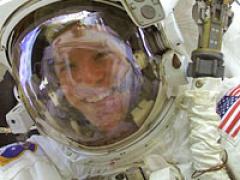
Extreme environments can be found on Earth, in space, and in the depths of the ocean. Dr. Biology and physiologist, astronaut, and mountain climber Scott Parazynski sit down and talk about what life is like to explore these environments. So hold on to your seat as we blast off…

If you spend some time hiking around the American Southwest, you might be lucky enough to spot a Gila monster. But you probably won't see one climbing a tree.

Wait - there's more! Dr. Biology and co-host Jane Rector continue their visit with Jennifer Fewell, a biologist who is exploring the world of social insects including ants. There is even some talk of how professional basketball teams could learn a thing or two…
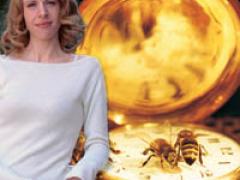
An interview with biologist Gro Amdam, one of the members of the group that brought us the bee genome. Hey just what is a genome and could bees hold the answer to aging? In this show we learn the answers to these questions and why researchers are buzzing around bees.
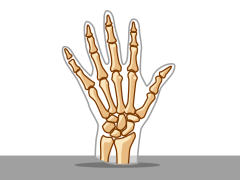
Explore the Bone Anatomy Viewer
Ever wonder what’s inside your bones? Here’s your chance to find out! Dissect a virtual bone and learn…
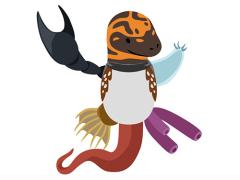
Dr. Frankenstein needs your help to learn about how the bodies of different animals work! Build your own creature from 3…

Some of the fastest animals on Earth are below. That’s right, if these tiny insects were as large as a horse they would be running 200 miles an hour.
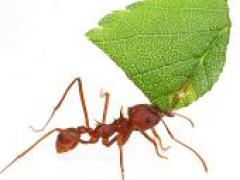
Now is the time to check out these amazing animals from the safety of your own computer.

Take a look at the microscopic world of bone in our virtual bone histology lab. Just pick a microscope slide from below and click on it to view under the virtual microscope.
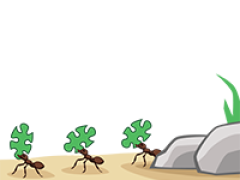
There are several different ways to get ants for an ant farm, depending on when you would like to start the farm and how long you would like for your ant farm to last.
Wordsearch | Crossword
Did you ever wonder why you see the colors you do or if other animals see the same colors that you see? We see light that bounces off of things around us. When the light enters our eyes,…
Wordsearch | Crossword
Let’s take a ride. It is going to be a fast one, so be prepared. Where are we going? We are going to start at your head and end up at your toes. It may not seem like a long trip, but it is…
Wordsearch | Crossword
All living beings are made up of cells. Some of them are made up of only one cell and others have many cells. Also in: Español |…
Wordsearch | Crossword

