





show/hide words to know
Composition: combining individual parts or pieces to make a new product. An author uses words to write a story and a musician combines notes to make a song.
Mimic: to copy or imitate the way something, looks, walks, talks, sings, or moves... more
Ornithologist: a person who studies birds... more
Virtual: a simulated (made up) environment based on the real world. Often computers are used to create virtual worlds.
Birds in Music
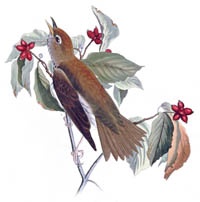
Wood Thrush by John James Audubon
So birds can fly, swim, and show off some cool colors and patterns. They can also make some pretty amazing sounds. The musical ability of birds has not gone unnoticed by musicians who have included them into their music either using instruments to mimic them, or actually including real bird songs into their compositions.
Some of the bird songs in our virtual aviary have starred in some musical works. Composer Z. M. E. Barnes created two wonderful musical pieces that she shares with us. Listen in and then read her story behind these two compositions.
Tall Grass Episodes byZ. M. E. Barnes [length 5:22] download
Chetowaik’s Nest byZ. M. E. Barnes [length 5:15] download
Notes from the Composer
Do you think birds sing the same sound again and again?
Have you ever tried to whistle a birdcall? Or even just recognize one? How do you make a musical instrument sound like a bird? How do you interact musically with birds? These were some of the questions I thought about when I decided to write compositions using bird sounds.
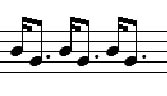
The first birdcall I learned to recognize was the Wood Thrush, which sounds like a flute player up in a tree. Next was another thrush, the American Robin. If you play drums or some other instrument, you can pick out one of the main parts of the robin's rhythm: ta-dum, ta-dum, ta-dum.
A couple of years ago my family decided to raise pheasants over the summer. That was my best and most detailed introduction to bird sounds. The pheasants loved music, too. When they heard me playing the piano, they immediately crowded around the window to listen. Our pheasants had a musical language of their own. They called “Unknown bird warning,” “I’m happy,” “Lost chick!” “Following Mom and Dad,” “New food,” “Keep out of my territory,” and “Is that a snake?” Each call was unique, and most of them were in a sound range that I could easily make. Learning to imitate them was the best part of the summer.
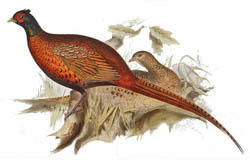
Common Pheasants by Edward Lear
Birds and other animals have been inspiring composers and poets for a long time. And birds have been very valuable to my life since I was a kid. They were fun to watch, to feed, and to listen to.
These two compositions are my way of reminding everyone that we have this one planet to call home. Caring for our home has always been an important goal. Recycling, gardening, composting, and not wasting things were part of the everyday code in my family. To us, every day was Earth Day.
I composed these Earth Day pieces using bird sounds because it was the just the thing to do. They are my reminder that we need to take care of what we have and protect it long into the future.
Z. M. E. Barnes
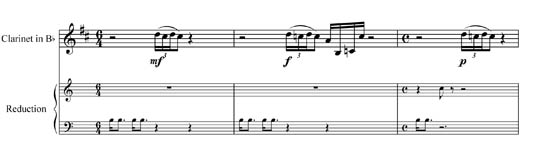
Download the reduced score versions of these two musical compositions
| Tall Grass Episodes | Chetowaik's Nest |
Other Composers Who Have Used Bird Songs
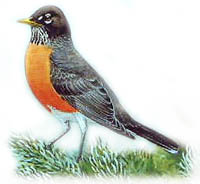
American Robin by U.S. Fish and Wildlife Service
Songs like When the red, red robin goes bob, bob, bobbin' along with its familiar tune by Harry M. Woods were inspired by birds. The American Robin was the bird that was bob, bob, bobbin for this familiar -
Wake up, wake up, you sleepy head,
Get up, get up, get out of bed
Olivier Messiaen a French composer, organist and not surprising an ornithologist also used bird songs in his works. An early composition is Le merle noir (The Blackbird) a flute and piano piece based on the song of the blackbird. A few years later he expanded the use of bird vocals to create his orchestral work Réveil des oiseaux (Awakening of the Birds).
About the artist: Z. M. E. Barnes is a composer, organist and musicologist who lives in Denton, Nebraska. These works are used with permission.
View Citation
Bibliographic details:
- Article: Birds in Music
- Author(s): Pierre Deviche, David Pearson, CJ Kazilek
- Publisher: Arizona State University School of Life Sciences Ask A Biologist
- Site name: ASU - Ask A Biologist
- Date published: May 6, 2010
- Date accessed: April 17, 2024
- Link: https://askabiologist.asu.edu/birds-music
APA Style
Pierre Deviche, David Pearson, CJ Kazilek. (2010, May 06). Birds in Music. ASU - Ask A Biologist. Retrieved April 17, 2024 from https://askabiologist.asu.edu/birds-music
Chicago Manual of Style
Pierre Deviche, David Pearson, CJ Kazilek. "Birds in Music". ASU - Ask A Biologist. 06 May, 2010. https://askabiologist.asu.edu/birds-music
Pierre Deviche, David Pearson, CJ Kazilek. "Birds in Music". ASU - Ask A Biologist. 06 May 2010. ASU - Ask A Biologist, Web. 17 Apr 2024. https://askabiologist.asu.edu/birds-music
MLA 2017 Style

With Bird Finder you can locate and learn about birds in the southwest. The collection has almost 300 birds. There are images, range maps, and their songs and calls. You can also select and compare different birds.

Coloring Pages
and Worksheets

Puzzles
Be Part of
Ask A Biologist
By volunteering, or simply sending us feedback on the site. Scientists, teachers, writers, illustrators, and translators are all important to the program. If you are interested in helping with the website we have a Volunteers page to get the process started.
