





show/hide words to know
Endurance: the ability to keep doing an activity for a long period of time. Marathon runners are know for their endurance.
Fitness: an individual's success in surviving and producing offspring, often measured by the number of offspring an organism has that survive to reproductive age. Fitness may also mean a measure of health, or how healthy a person is.
Something for Your Mind and Body
| Now that you know something about human physiology and exercise it is time to think about an experiment. Before you jump or run into an exercise program it is good to know what exercise scientists call your level of fitness. This way you can track how you improve over time. This can also be a great experiment to try out on your family and friends. | Keep in mind that you should always check with your parents and/or family doctor to be sure you are healthy enough to start your exercise program and what exercises are best for you. |
Materials and Tools

There are three items you will need to conduct your experiment. A bench that is stable and safe for stepping up and down. This should be 1-2 feet high. You will also need a notebook or the printed journal sheet and a pencil or pen. A cloth measuring tape or a piece of string can be used for any body measurements. The final item for your experiment is a stopwatch or a watch with a second hand.
Designing Your Own Experiment
- First find a bench or step that is about 1-2 feet high. Get a stop watch or a watch with a second hand, a pencil, and piece of paper to write down your results. If you want you can print this journal example that includes a blank sheet to record your results.
- Take your resting pulse (heart rate) and write it in your journal.
- Now step up and down on the bench for 2 minutes. After 2 minutes, immediately sit down and take your pulse rate and write it in your journal.
- You have now measured your baseline fitness level.
Now that you have a starting point from which you can measure, you can plan your exercise routine. Think of what questions you want to answer. For example:
- How long will it take before you see improvements in your resting heart rate?
- How long will it take before you see a change in your recovery heart rate?
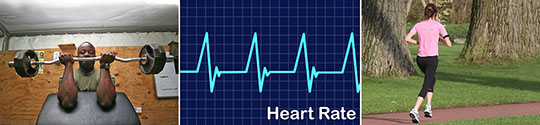
Additional Measurements You Can Include in Your Experiment
In addition to your heart rate, here is a list of things that you can measure with just a watch, or clock with a second hand and a string or cloth tape measure. Be sure to record your starting information for any of these items that you add to your experiment.
- Resting heart rate
- Before you begin exercise
- Heart recovery rate (how fast your heart recovers from exercise)
- Choose an interval to record (example - every minute up to 5 mintues)
- Weight
- It is best to do this first thing in the morning.
- Body size (waist, chest, hips)
- BMI (body mass index or body fat)
- Calcuate your BMI with this calculator from the CDC.
- Strength
- How much weight you can lift
- Endurance
- How long, and how many repetitions of some exercise
Additional images via Wikimedia Commons and Creative Commons.
View Citation
Bibliographic details:
- Article: Designing Your Own Exercise Experiment
- Author(s): CJ Kazilek, Gabriel Shaibi
- Publisher: Arizona State University School of Life Sciences Ask A Biologist
- Site name: ASU - Ask A Biologist
- Date published: September 30, 2009
- Date accessed: April 17, 2024
- Link: https://askabiologist.asu.edu/explore/designing-your-own-experiment
APA Style
CJ Kazilek, Gabriel Shaibi. (2009, September 30). Designing Your Own Exercise Experiment. ASU - Ask A Biologist. Retrieved April 17, 2024 from https://askabiologist.asu.edu/explore/designing-your-own-experiment
Chicago Manual of Style
CJ Kazilek, Gabriel Shaibi. "Designing Your Own Exercise Experiment". ASU - Ask A Biologist. 30 September, 2009. https://askabiologist.asu.edu/explore/designing-your-own-experiment
CJ Kazilek, Gabriel Shaibi. "Designing Your Own Exercise Experiment". ASU - Ask A Biologist. 30 Sep 2009. ASU - Ask A Biologist, Web. 17 Apr 2024. https://askabiologist.asu.edu/explore/designing-your-own-experiment
MLA 2017 Style
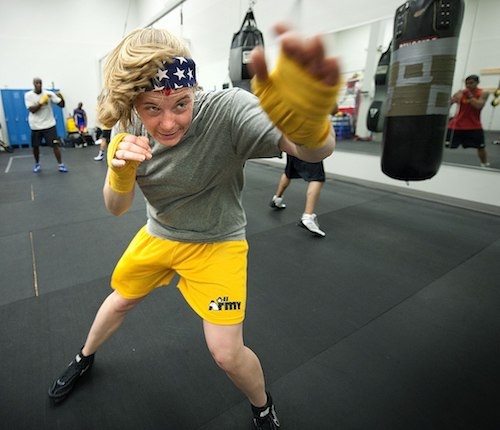
Designing an exercise experiment is a great way to learn and help your body at the same time.

Coloring Pages
and Worksheets
Be Part of
Ask A Biologist
By volunteering, or simply sending us feedback on the site. Scientists, teachers, writers, illustrators, and translators are all important to the program. If you are interested in helping with the website we have a Volunteers page to get the process started.
